
Milk safety
Aflatoxin M1 in milk: control from feed to intake
Aflatoxin M1 requires a dedicated test: normal milk fat, protein and acidity do not establish its absence. Effective control connects feed testing, milk testing before batches are mixed and a clear response to suspect results. LabLog helps farms and dairy processors implement this workflow in Uzbekistan.
In short
How aflatoxin M1 reaches milk
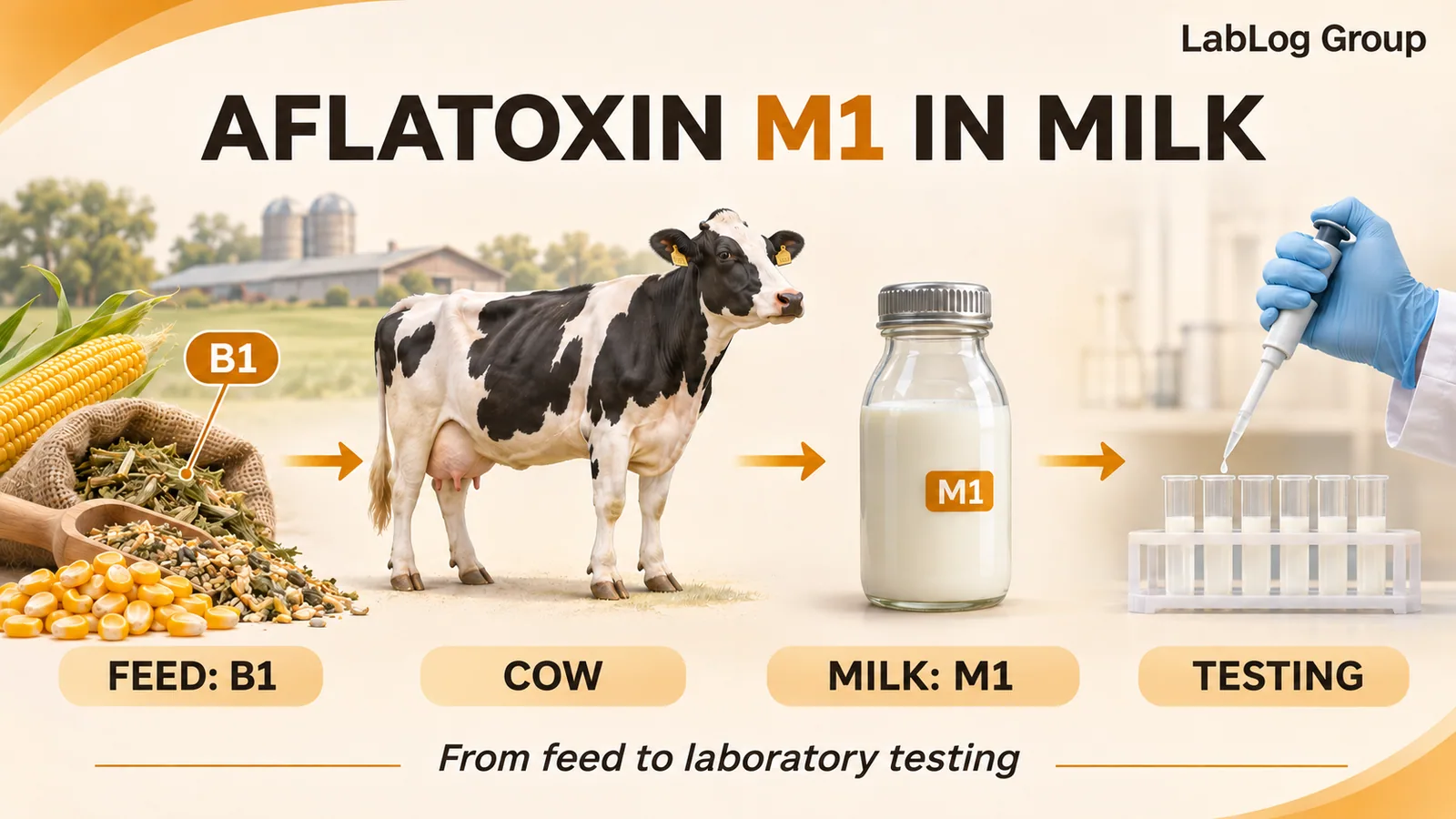
The chain starts with feed contaminated by aflatoxin B1. Animals metabolise part of B1 into M1, which is excreted in milk. Investigating M1 therefore extends beyond the tanker to feed sources, ingredient batches and storage conditions.
Moulds may develop before harvest and during storage. Appearance cannot replace testing, and a negative sample does not clear future deliveries. Farms can identify a problem before dispatching milk.
Science note: why one B1 value cannot predict milk M1
Aflatoxin M1 is formed when animals metabolise B1. Feed-to-milk transfer depends on toxin intake, milk yield and individual animal differences. Britzi et al. (2013) investigated transfer in high-yielding cows in relation to production and lactation stage.
LabLog’s practical conclusion: a universal conversion factor cannot replace milk testing. Findings from a particular herd are not a guarantee for another farm.
Why pasteurisation does not replace testing
Aflatoxin M1 is a chemical contaminant, not a living microorganism. Pasteurisation is not a reliable way to eliminate this hazard. Routine filtration or acceptable composition values also cannot establish that a batch is safe.
Antibiotic residues, microbial contamination and M1 are different testing tasks. A negative antibiotic test is not an M1 result. MilkoScan supports composition control but does not replace a dedicated aflatoxin assay.
Science note: hazard and risk are different
The EFSA scientific opinion (2020) assesses aflatoxins as genotoxic carcinogenic contaminants. Risk assessment considers exposure, including food concentration and consumption, rather than presence alone. Detecting a trace does not mean that a specific person will develop disease.
For a producer, the appropriate response is contamination control and compliance with the applicable limit. M1 having lower toxicological potency than B1 does not remove the need for control.
Uzbekistan: match the limit, units and product category
SanQvaN No. 0095-25, annex clause 2.1.15, specifies an aflatoxin M1 maximum level of 0.050 µg/kg for raw milk. This equals 50 ng/kg or 0.05 ppb on a mass-fraction basis. Values in µg/L and µg/kg must not automatically be treated as identical.
Infant foods have separate categories and conditions. Do not apply the raw-milk limit to every dairy product. Check the exact category and current legislation before release. Regulation No. 474 of 7 July 2017 ceased to apply on 2 September 2025 and is not a current legal basis. Regulatory links checked on 12 November 2026.
Selecting a Bioeasy aflatoxin M1 test
Start with the product, required decision level and qualitative or quantitative result. Then select the exact kit, compatible incubator and reader, controls and consumables. An “aflatoxin test” label is insufficient: a feed kit is not automatically suitable for milk, and a raw-milk procedure does not automatically cover cheese or milk powder.
Bioeasy YRM1004D-2 is a quantitative immunochromatographic aflatoxin M1 assay for milk. This version specifies 2 + 8 minutes at 40 ± 2 °C and 96 tests per kit. These settings must not be transferred to other kit codes. We check the current instructions, measuring range and performance near the required limit before selection. Follow the selected kit instructions for temperature, sample volume and reading.
Science note: “not detected” does not mean zero
The limit of detection (LOD) concerns the smallest amount a method can detect; the limit of quantification (LOQ) concerns quantitative measurement with defined performance. A screening cut-off and a legal maximum are also different values.
ISO 14501:2021 describes an HPLC method with an LOQ of 0.01 µg/kg for liquid milk and 0.1 µg/kg for milk powder. These are characteristics of that method, not of a Bioeasy rapid test. Select a kit using its own sensitivity, matrix scope and decision rule near the limit.
Milk intake: from sample to batch decision
Arrange testing before a delivery is mixed with accepted milk. Use an established representative sampling procedure and record supplier, batch, date, time and storage conditions. A multi-compartment tanker needs a sampling plan that accounts for its separate compartments.
Check kit expiry and storage, incubator temperature and reader settings. Use controls according to the instructions and laboratory procedure. Record results with units, kit code and lot, operator and batch disposition. Set testing frequency according to risk, site requirements and applicable rules; increase attention after changes in feed, supplier or adverse findings.
Positive or doubtful screening: what to do
Hold the batch separately and do not release it for processing until the responsible specialist decides its disposition. Review sampling, test execution, controls, units and decision threshold. Repeat under an investigation procedure, not until a convenient negative result appears.
Where needed, send a retained representative sample to a competent laboratory for confirmation. ISO 14501:2021 describes M1 determination in milk and milk powder by HPLC with immunoaffinity clean-up. It is an analytical method, not a maximum-limit regulation. Trace the delivery back to the farm and investigate feed in parallel. Mixing with clean milk is not a way to correct a non-compliant batch.
Connecting feed and milk control
Feed requires an assay for the relevant toxin and matrix, with its own sampling, grinding and extraction procedure. A milk M1 kit cannot replace B1 testing in grain or compound feed.
Wile supports moisture control in suitable feed materials; AuroraNir supports composition analysis within available calibrations. These instruments complement feed quality management but do not establish aflatoxin absence. A negative milk result also does not clear feed of all mycotoxins. Each tool must answer its own question.
How LabLog implements the workflow
We start with your workflow: milk and product types, batches per shift, required decision level and release point. We select tests and compatible equipment, organise supply and commissioning and train your staff.
Training covers sampling and preparation within the selected method, incubator and reader operation, controls and recording. We supply consumables and provide technical and application support. Where official confirmation is required, we help coordinate with a competent laboratory. Send an enquiry so we can configure a solution for your farm or plant.
FAQ
FAQ
Will an antibiotic test detect aflatoxin M1?+
Only if M1 detection is explicitly included in that kit’s intended use. A standard antibiotic result says nothing about aflatoxin.
Can one kit test both milk and feed?+
Only within the matrices and procedures explicitly validated for the kit. Milk M1 and feed B1 normally require different assays and sample preparation.
What M1 limit applies to raw milk in Uzbekistan?+
Annex clause 2.1.15 of SanQvaN No. 0095-25 sets 0.050 µg/kg. Check the product category and current edition before applying it.
Sources and documents
- WHO — Mycotoxins
- WHO — foodborne hazards and M1 persistence after pasteurisation
- Bioeasy — YRM1004D-2 quantitative M1 assay
- LexUZ — SanQvaN No. 0095-25, annex 2.1.15
- LexUZ — repealed Regulation No. 474
- ISO 14501:2021 — M1 determination by HPLC
- Britzi et al. (2013) — feed B1 to milk M1 carry-over
- EFSA (2020) — risk assessment of aflatoxins in food