
Bioeasy
Antibiotics in milk after cow treatment: when milk can be used safely
After cow treatment, the decision should not be based on the calendar alone. The required number of days may have passed, but different cows can deplete antibiotics differently. The real question is: “can we trust this milk right now?”. For a family, it is a safety question. For a farm, it is money and reputation. For a dairy plant, it is the whole raw-milk batch.

In short
The problem: antibiotic residues are invisible
Milk can look normal, smell normal and taste normal, while still containing antibiotic or inhibitor residues. For the consumer, this is a trust and safety question. For the farm, it is a risk of rejected milk. For the dairy plant, it is a risk of sending problematic raw milk into production.
The most sensitive moment is after treating a cow. The farmer observes the stated withdrawal period, the animal looks healthy, and milk needs to return to the common flow — but confidence is not yet complete. At that point, it is better to test one sample than risk the whole tank.
Why “the required days have passed” is not a full guarantee
Every veterinary medicine has a milk withdrawal period. This is the time during which milk from a treated cow must not be sent to the common tank or for processing. It must always be respected.
But it is important to understand: the withdrawal period is not a “magic date” after which milk automatically becomes safe. Actual antibiotic depletion depends on dose, administration route, animal condition, treatment reason, productivity and the individual physiology of that cow.
The practical logic is simple: first observe the withdrawal period, then check a sample with a rapid test. This gives the farm not a calendar guess, but a more confident decision about the specific milk.
What to test: BSCT, 16in1 and other formats
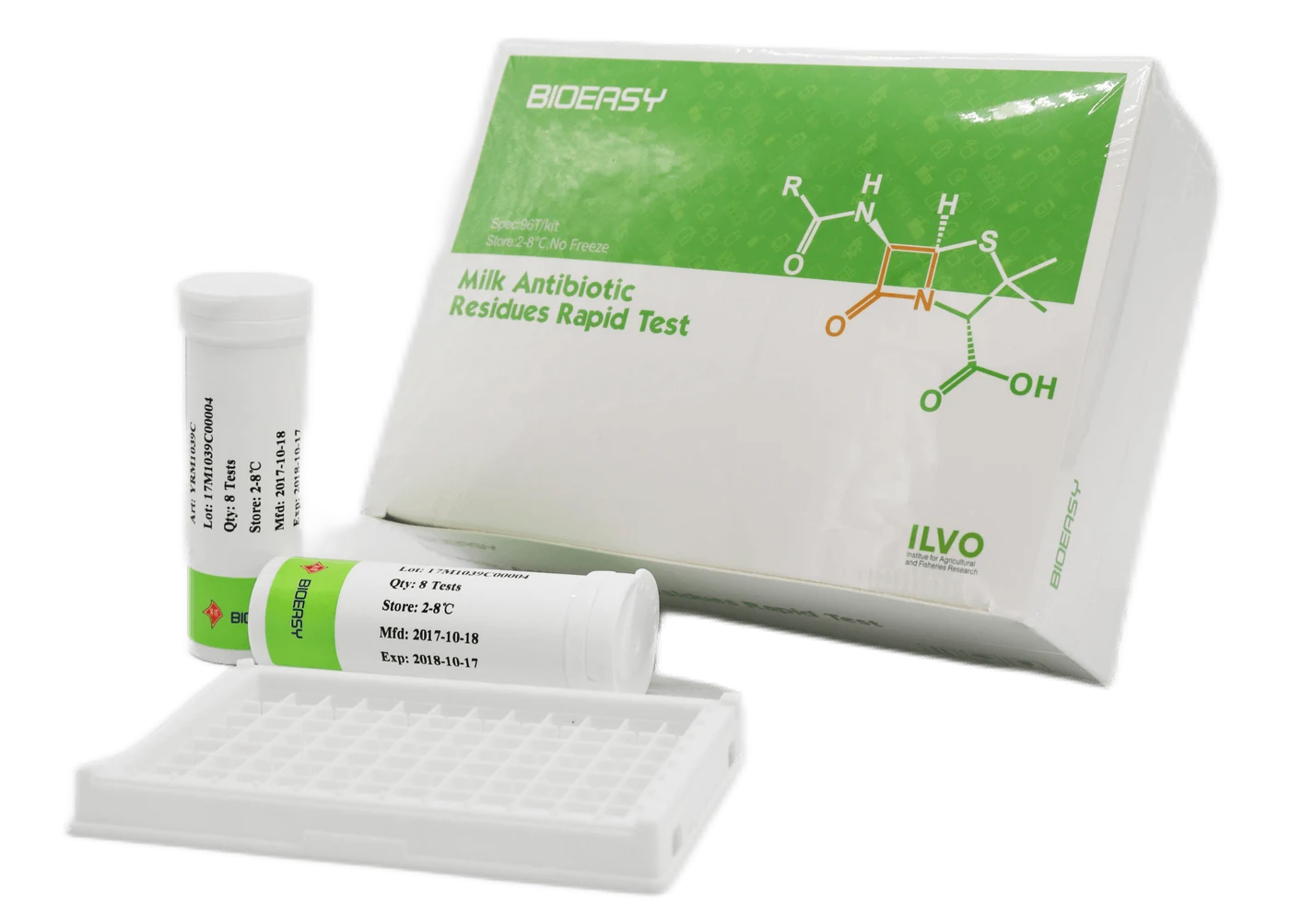
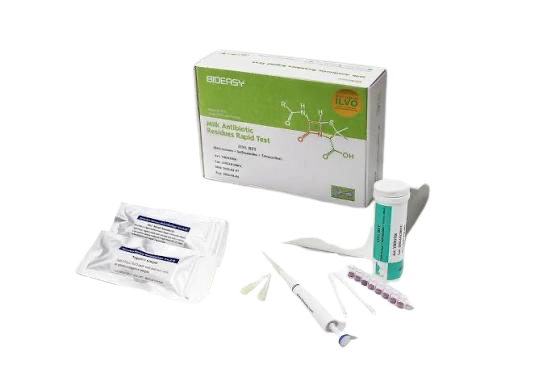
In daily practice, the first need is fast screening of the most important groups. LabLog keeps Bioeasy 4in1 BSCT in regular stock — a test for beta-lactams, streptomycin, chloramphenicol and tetracyclines. These groups are especially important in dairy control because they relate to common veterinary treatments and raw-milk safety requirements.
For broader control, Bioeasy 16in1 and other solutions are used: for antibiotics, inhibitors, hormonal substances and specific enterprise tasks. The widest test is not always necessary. The correct choice starts with risk: which medicines are actually used on the farm, what the dairy plant requires and which substance groups most often create intake disputes.
The solution: Bioeasy test + incubator + clear workflow
A rapid test is not just a “checking strip”. It is a small laboratory procedure. For a trustworthy result, three things matter: the right test, an incubator and execution discipline.
The incubator is mandatory. Bioeasy tests depend on temperature and reaction time: without controlled temperature, test sensitivity and the milk decision become less reliable. A reader is not required for every user, but it is useful where digital interpretation, printing, result storage and reduced subjectivity are important.
- The farm checks milk before it enters the common tank.
- Milk reception checks raw milk before production.
- The laboratory documents procedure, result and disputed cases.
What ILVO is and why it matters
ILVO is the Flanders Research Institute for Agriculture, Fisheries and Food, an independent research institute in Belgium. In simple terms, ILVO evaluates methods and publishes validation reports showing how a test performs under controlled validation conditions.
Bioeasy has ILVO validation reports for milk antibiotic tests. This matters because the manufacturer is not only saying “our test is good”. There is independent validation of method performance, sensitivity and applicability. Not every rapid test can show this level of validation, which makes ILVO important for dairy plants, laboratories and larger farms.

Workflow after cow treatment
A practical workflow must be simple enough to be followed every day, not only during audits.
- Mark the treated cow and keep her milk out of the common tank.
- Observe the withdrawal period according to the medicine and veterinarian’s instruction.
- Before returning milk, run a Bioeasy rapid test with an incubator.
- If the result is negative, milk can return according to the farm’s internal procedure.
- If the result is positive, keep milk separate and repeat testing later.
What matters for each participant
Antibiotic control in milk is not the task of one laboratory operator only. It is a chain of decisions from cow to glass. Each participant has a different risk, but the goal is the same: do not allow untrusted milk into the chain.
- A farm needs to avoid putting the whole tank at risk with milk from one treated cow: a practical kit is Bioeasy 4in1 BSCT + incubator.
- A dairy plant needs to avoid accepting a problematic lot: for larger flows, Bioeasy 16in1, incubator and, if needed, Reader can be useful.
- A laboratory needs documented procedure and result: a reader helps reduce subjectivity and store data.
- A consumer needs to understand: residues cannot be tasted, so quality must be controlled before milk reaches the shelf.
Common mistakes that break control
Even a good test can be ruined by incorrect use. That is why buying tests is not enough — a clear procedure must be implemented.
- Running the test without an incubator. This is the main mistake: without the required temperature, the reaction does not run as intended by the manufacturer.
- Treating the number of days passed as a complete guarantee. The withdrawal period is mandatory, but antibiotic depletion depends on the individual cow.
- Returning milk to the common tank “by eye”. Residues cannot be detected by appearance, smell or taste.
- Not recording the result. Documentation helps investigate disputed lots and train staff.
Standards: where rapid tests fit
The current EAEU/Russian requirements for food of animal origin include changes introduced by EEC Council Decision No. 70 of 23 June 2023; the same decision repealed the previous EEC Board Decision No. 28 on maximum residue levels of veterinary medicines. In practice, this means that veterinary drug residues are not a secondary topic, but part of the mandatory food-safety system.
For Uzbekistan, the national regulatory base is essential. SanPiN RUz No. 0366-19 for dairy products uses the “not permitted” principle and low detection levels for several antibiotics: chloramphenicol below 0.0003 mg/kg, tetracyclines below 0.01 mg/kg, penicillins below 0.004 mg/kg and streptomycin below 0.2 mg/kg.
GOST R 59507-2021 describes determination of antibiotic and drug residues in milk by immunological methods, including test kits and immunochromatographic solutions. For disputed cases, confirmatory instrumental methods are used, for example GOST 31694-2012 for tetracycline residues by HPLC-MS/MS. A proper control system therefore looks like this: rapid screening for daily decisions, confirmatory laboratory analysis for official investigation of complex cases.
FAQ: short answers
These questions often come from farmers, technologists, laboratories and milk consumers.
- Can milk be consumed after antibiotic treatment? Only if the antibiotic has fully depleted. The number of days passed is a guide, but the final decision is better confirmed with a test.
- When can milk be supplied after antibiotics? When the medicine has fully depleted from milk. The practical way to confirm this is testing.
- Can residues be detected by taste? No. Residue levels are too small to be detected by taste or smell.
- Why is an incubator needed? To run the reaction under manufacturer-defined conditions: temperature, time and reaction speed affect the result.
- How is 4in1 different from 16in1? They are different products for different tasks: 4in1 BSCT covers frequent control of key groups, while 16in1 is broader screening for larger plants and higher-control tasks.
The result: who benefits from proper control
The farm benefits because it does not risk the whole tank because of milk from one cow. The dairy plant benefits because problematic raw milk is stopped before production. The laboratory benefits because it receives a clear screening procedure. The consumer benefits because the chain gains an additional safety barrier.
LabLog Group is the official exclusive Bioeasy supplier in Uzbekistan. We usually keep Bioeasy 4in1 BSCT, Bioeasy Mini Incubator, Bioeasy Reader and broader screening solutions in stock. We help select tests according to real medicines used, milk-reception workflow, sample volume and enterprise requirements. The kit can be discussed at the LabLog showroom in Tashkent: 100043, Tashkent, Chilanzar-1, bld. 4.

FAQ
FAQ
When can milk be returned after treating a cow?+
When antibiotic residues are below the allowed level. Withdrawal depends on the medicine and the individual cow, so it is safer to test a sample before mixing it with common milk.
Can a consumer notice antibiotics in milk?+
Not reliably. Residues cannot be detected by taste or smell. Control is the responsibility of the producer and processor.
Why can one cow create a problem for the whole batch?+
Milk is mixed in a common farm tank. If milk from a treated cow returns too early, the risk moves to a much larger volume of product.
How does Bioeasy help in this situation?+
Bioeasy provides fast screening before returning milk to a tank or during intake. The method must be followed: correct test, incubator, time, temperature and staff training.
Sources and documents