
Calf housing
VDK Agri calf housing: choosing individual, pair or group systems
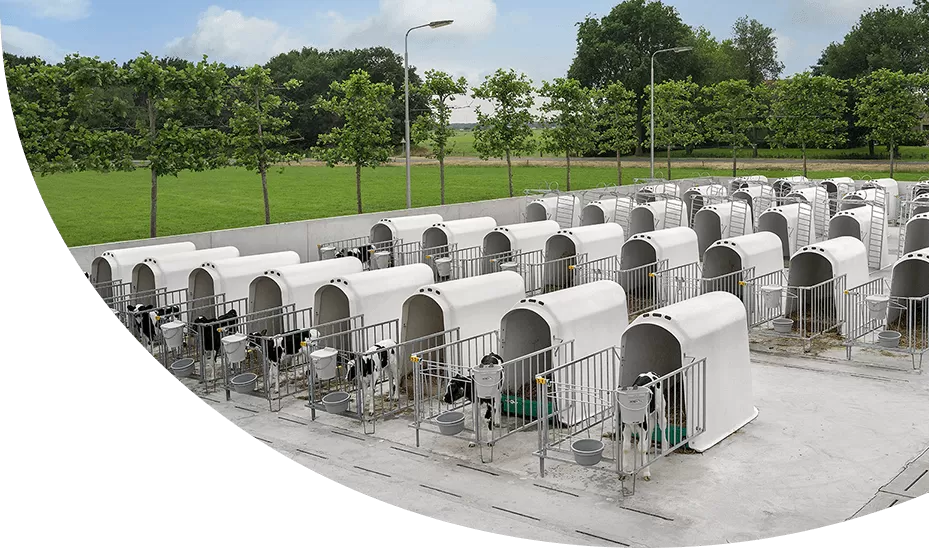
A calf hutch should not be selected by place count alone. The system must fit animal age and size, milk-feeding method, climate, prevailing wind, drainage, dry-bedding supply and wash route. VDK Agri offers indoor, individual, pair and group systems plus a Hybrid that changes configuration without moving calves to another shell. This guide explains a practical selection logic for farms in Uzbekistan.

In short
Quick selection
CalfOTel selection matrix: all 10 solutions
Start with the housing environment and format, then verify calf age and size, milk-feeding workflow and sanitation cycle. A model name alone does not determine the right choice.
Open Top
- Location
- Indoors or under a lean-to
- Age
- Catalogue guide: 0–4 weeks
- Format
- 1, 2 or 3 sections
- Application stage
- Early individual stage
- Choose when
- Direct visibility, access and a mobile section are needed
Open Top Premium
- Location
- Indoors or under a lean-to
- Age
- Catalogue guide: 0–9 weeks
- Format
- Single or Duo
- Application stage
- Individual indoor stage
- Choose when
- Removable grating, smooth panels and rapid cleaning are priorities
Indoor Combo
- Location
- Indoors or under a lean-to
- Age
- Defined by the farm protocol
- Format
- Individual, pair or group
- Application stage
- Transition from individual to group housing
- Choose when
- An expandable 100 or 120 cm-wide row is needed
Small
- Location
- Outdoors
- Age
- Not specified separately by the manufacturer
- Format
- 1 calf
- Application stage
- Compact individual stage
- Choose when
- Space is limited and the housing period is predefined
Plus
- Location
- Outdoors
- Age
- Manufacturer guide: 0–6 weeks
- Format
- 1 calf
- Application stage
- Individual housing for the first weeks
- Choose when
- A standard individual hutch for the first weeks is needed
Comfort
- Location
- Outdoors
- Age
- Manufacturer guide: 0–8 weeks
- Format
- 1 calf
- Application stage
- Extended individual stage
- Choose when
- More length and space are required than Plus provides
XL-2
- Location
- Outdoors
- Age
- Start at 0–3 weeks; housing until 8–12 weeks
- Format
- 2 calves
- Application stage
- Pair housing
- Choose when
- Each calf can be monitored for milk intake and condition
XL-5
- Location
- Outdoors
- Age
- After individual housing to about 3 months
- Format
- Up to 5 calves
- Application stage
- Small same-age group
- Choose when
- A compact group is needed after individual or pair housing
XL-10
- Location
- Outdoors
- Age
- After individual housing to about 3 months
- Format
- Up to 10 calves
- Application stage
- Larger same-age group
- Choose when
- Feeding frontage, water and whole-group observation are designed
Hybrid
- Location
- Outdoors
- Age
- From day one to about 3 months
- Format
- 4×1, 2×2, 1×4 or 1×3 + 1×1
- Application stage
- Individual-to-group transition
- Choose when
- Group size must change without moving calves to another shell
Age ranges are manufacturer guides, not automatic transfer dates. Where no model-specific age is published, timing follows actual calf size and health, site conditions and the approved farm protocol.
The range by rearing stage
For indoor housing VDK Agri offers Open Top, Open Top Premium and the expandable Indoor Combo. The outdoor individual range comprises Small, Plus and the larger Comfort. XL-2 is for a pair. XL-5 and XL-10 are designed for groups of five and ten calves. Hybrid can begin as four individual places and later become pairs or one group. Catalogue ages are manufacturer guidelines rather than automatic transfer dates; actual size, health and the farm protocol determine the move.
- Indoor: Open Top, Open Top Premium, Indoor Combo
- Individual: Small, Plus, Comfort
- Pair: XL-2; groups: XL-5 and XL-10; flexible layout: Hybrid
When to choose an indoor system
Open Top suits situations where staff need direct newborn access and a mobile section. Open Top Premium adds smooth panels, a galvanised frame, removable grating and Single, Duo and Triple versions. Indoor Combo uses 100 or 120 cm base and extension modules for a wall row, a row with a rear wall or two rows sharing a rear wall. Barn ventilation must be checked before ordering: an open top cannot correct stagnant air, excessive humidity or draughts.
Small, Plus or Comfort
These models share one purpose—individual outdoor housing—but differ in space allowance and intended duration. The manufacturer currently lists Plus for about 6 weeks and Comfort for about 8 weeks; Small is the most compact option. Each model has multiple fence configurations. Selection should reflect breed and calf weight, individual-stage duration, available site and daily handling rather than assuming that the largest is always best.
Pair and group housing
XL-2 is designed for two calves, XL-5 for five and XL-10 for ten. As group size rises, similar age and weight, sufficient feeding frontage, water access and visibility of every calf become more important. Group housing should not be treated merely as a space-saving measure: the layout must limit competition for milk and feed and provide a separate observation place when an animal needs it.
What Hybrid changes
Hybrid addresses the transition itself: removable partitions create four individual places, two pairs, one group of four, or a group of three plus one separate place. Calves need not move to another shell, but the transition still requires control. Staff need rules for removing partitions, monitoring milk intake, forming compatible groups, replacing bedding and sanitation. The front flap changes the opening for weather conditions but does not replace site-specific heat-load and wind assessment.
The site matters more than a neat row
Before positioning hutches, check prevailing wind, sun path, shade during hot hours, slope and drainage, hard standing, vehicle access and distance from adult animals. Clean and dirty routes should not cross unnecessarily. Empty hutches move to a dedicated washing and drying zone; each new group receives a prepared place and dry bedding. Uzbekistan projects require a separate assessment of summer heat load and actual shade availability throughout the day.
Accessories are part of the system
The fence determines not only exercise area but also staff access, bucket positions and cleaning order. The catalogue includes standard and teat-bucket holders, troughs, hay racks, Milk Feeders, entrance curtains, calf jackets and the Dolly handling cart. Configure accessories after defining feeding and sanitation; otherwise the hardware may not fit daily work.
What LabLog needs for selection
A preliminary layout needs calving numbers, simultaneous calf counts by stage, breed and weight, duration of the individual period, feeding method, site plan and site photos. Water, power, handling equipment, wash-area capacity, bedding supply and staff routine are then confirmed. The output should be a plan of places, transitions, fences, feeding and sanitation breaks—not merely a hutch list.
FAQ
FAQ
Which VDK Agri hutch should be chosen for one calf?+
Small, Plus and Comfort differ in size and intended duration. Breed, weight, transfer age and available space determine the choice. The current manufacturer site positions Plus at about 0–6 weeks and Comfort at about 0–8 weeks.
How does XL-2 differ from XL-5 and XL-10?+
XL-2 is for a pair, XL-5 for five calves and XL-10 for ten. They are not interchangeable sizes: feeding frontage, water, bedding, observation and sanitation must be designed for each group.
Can calf hutches be placed directly on soil?+
This depends on slope, drainage, bearing capacity and sanitation flow. The site must remain dry, allow cleaning and avoid collecting runoff beside the calf.
Does the hutch solve heat stress by itself?+
No. A white shell and ventilation openings help manage conditions, but hot weather still requires correct orientation, shade, unrestricted airflow, water and regular calf observation.
What is included in supply?+
Configuration varies by model: shell, threshold or fence, rings and holders, feeders, hay racks, curtains and handling tools are selected for the project. LabLog records the final scope in the specification.
Sources and documents