
Veterinary PCR diagnostics
Real-time PCR in a veterinary laboratory: from sample to KadieCheck result
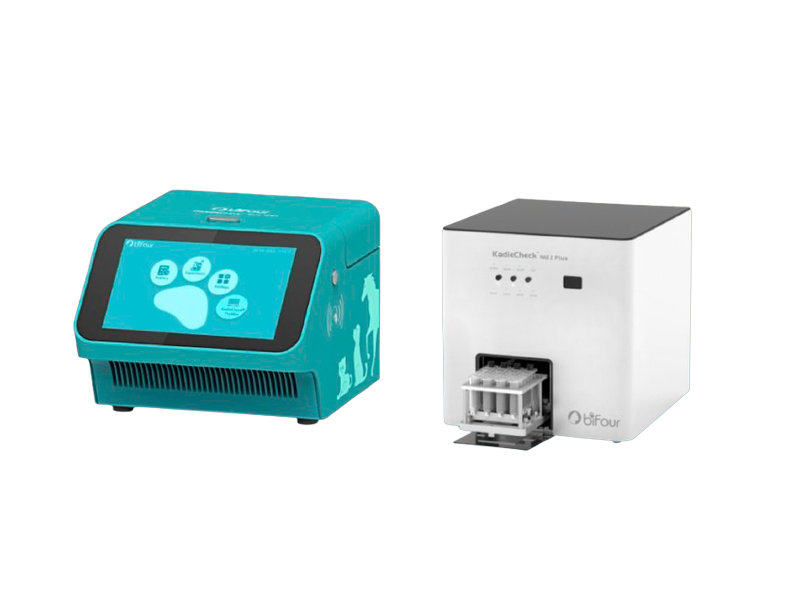
Real-time PCR is more than an analyser and a Start button. Result quality is formed across the entire chain: the clinical question, correct specimen and sampling time, transport, DNA or RNA extraction, inhibition control, reaction setup and interpretation. This guide explains that chain using the compact eight-well KadieCheck™ system, BIFOUR veterinary panels and the NAE 2 nucleic-acid preparation module.

In short
1. Start with the diagnostic question
Before selecting a panel, define the animal species, syndrome, suspected agent, disease stage, vaccination and prior treatment. One symptom can be associated with different agents, while detecting genetic material does not always prove causation. PCR therefore complements history, examination and other laboratory methods; it does not replace veterinary judgement.
The BIFOUR menu includes single assays and combined panels for respiratory, gastrointestinal, vector-borne and selected zoonotic infections in cats and dogs. A panel should be selected by clinical question, species and accepted specimen type—not simply by choosing the largest number of targets.
2. Preanalytics: where quality is often lost
A negative result may reflect poor timing, an unsuitable matrix, too little material, nucleic-acid degradation or inhibitors rather than absence of the agent. WOAH requires diagnostic specimen collection, identification, packaging, transport and storage to be documented. Only specimen types and conditions stated in the assay instructions should be used.
The practical route should record the animal and sampling time, anatomical site, container and transport medium, delivery temperature and duration, acceptance conditions and rejection criteria. PCR sensitivity cannot repair a leaking, mislabelled specimen or one with an unknown history.
- Before sampling: confirm the specimen type and assay instructions
- At receipt: check identity, integrity, time and temperature
- Before analysis: prevent mix-ups and repeated freeze-thaw cycles
3. DNA or RNA extraction: the role of NAE 2
Before amplification, cellular or viral material is lysed, nucleic acid is separated from proteins, salts and other matrix components, and the extract is transferred into the reaction. Errors can reduce recovery or carry inhibitors forward. NAE 2 is intended to standardise repetitive preparation steps and reduce operator-to-operator variation.
Automation is not universality: the protocol, reagents, input and elution volumes must match the specimen and assay. An internal control can reveal extraction problems or inhibition, but its purpose and acceptance criteria must follow the assay instructions.
4. Controls: when a run can be interpreted
A positive control confirms that the chemistry and programme can produce the expected signal. A no-template reagent control helps detect setup contamination. A negative extraction control travels with specimens and monitors contamination introduced during preparation. An internal control checks defined process failures—such as extraction or inhibition—within the intended design of the assay.
Control composition, frequency and acceptance criteria come from the validated method. If a required control fails, convenient sample results cannot simply be selected: investigate and document the deviation, then repeat the relevant stage or run when required.
5. What KadieCheck does
KadieCheck is a compact real-time fluorescence PCR analyser. BIFOUR states that it runs eight 0.2 ml reactions, uses Peltier heating and cooling, monitors temperature and provides preset programmes. The manufacturer lists 50–60 minutes for amplification; this is not the complete turnaround time from specimen receipt to authorised report.
Eight wells can suit modest volumes and urgent runs, but capacity must include controls. If the method requires several controls and replicates, fewer than eight wells remain for specimens. Throughput calculations should include registration, preparation, extraction, setup, amplification, curve review and reporting.
6. How to read Cq and the amplification curve
Cq (often called Ct) is the cycle at which signal crosses a defined threshold. A lower value generally corresponds to more starting target within the same method, but Cq values should not be compared directly across assays, laboratories or matrices without demonstrated comparability. Thresholds, baselines, reaction efficiency, inhibition and material quality all affect the value.
The report follows the manufacturer’s algorithm: curve shape, accepted control range, target cut-off and internal-control behaviour. Borderline or atypical signals require the checks specified by the method. PCR detects target nucleic acid; by itself it does not prove organism viability and does not replace clinical assessment.
7. Zoning and contamination control
Amplified material contains vast numbers of target copies and can create false positives if carried into a clean area. The workflow should move in one direction: clean reagent storage and mix preparation → addition of extracted material → amplification and analysis. Zones use dedicated coats, gloves, pipettes and consumables, with approved decontamination procedures for surfaces and equipment.
Room design follows the laboratory’s risk assessment, but specimen, staff, waste and document flows should prevent reverse transfer. Filter tips, frequent glove changes and closed tubes reduce risk; they do not replace zoning, environmental control or investigation of recurring signals in negative controls.
8. Implementing BIFOUR in an Uzbek laboratory
A project starts with animal species, syndromes, specimens and expected volume—not with the analyser purchase. The laboratory then defines panels, control materials, extraction workflow, zones, pipettes, cold storage, consumables, training and report format. Before routine use, it confirms method performance under local conditions and establishes quality-control and deviation rules.
LabLog helps match KadieCheck, NAE 2 and BIFOUR panels to the laboratory task, configure the complete package and arrange supply, commissioning and training in Uzbekistan. The final configuration and assay menu are confirmed against current manufacturer documentation; clinical interpretation remains the responsibility of an authorised veterinary professional.
- Map of questions and specimens
- Complete configuration including controls and preparation
- Commissioning, training and documented quality control
FAQ
FAQ
How many specimens fit in one KadieCheck run?+
The instrument has eight wells, but method-required controls and any replicates use part of that capacity. Actual specimen count therefore depends on the assay layout.
Does a low Cq mean severe disease?+
Not automatically. Cq depends on target amount, sampling quality and site, preparation, reaction efficiency and analysis settings. It is interpreted only within the validated method and clinical context.
Can a negative PCR fully exclude infection?+
Not always. Timing and sampling site, low target level, degradation or inhibition can cause a negative result. Controls and specimen quality are reviewed before deciding on repeat or alternative testing.
Does NAE 2 replace the whole preparation workflow?+
No. It standardises the nucleic-acid extraction stage defined by the protocol. Receipt, primary specimen treatment, reagent selection, quality control and safe handling remain laboratory responsibilities.
Which BIFOUR panels are available?+
The official KadieCheck menu includes single and combined assays for selected respiratory, gastrointestinal, vector-borne and zoonotic targets in cats and dogs. Current availability, compatibility and specimen types are confirmed before ordering.
Sources and documents