
Forage storage
V12 Silver Cover: how an oxygen barrier supports silage protection
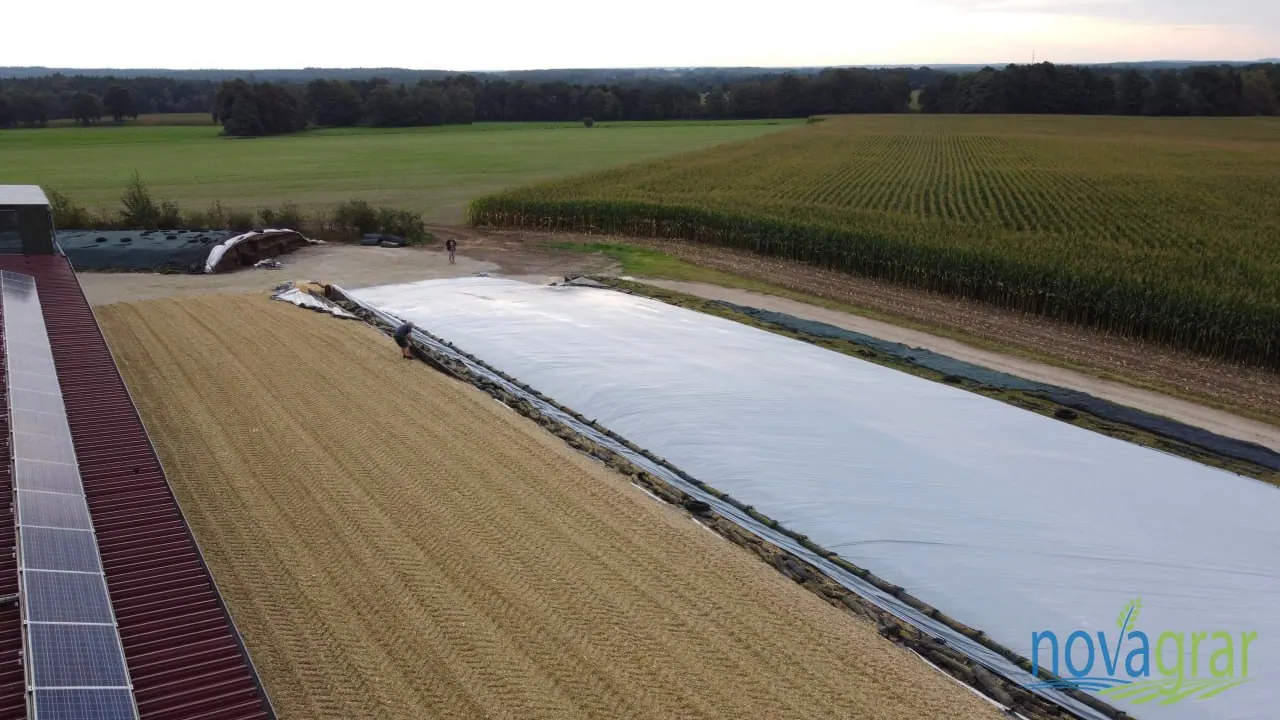
Silage remains dependent on airtightness after the clamp is covered. Air can enter through the material, overlaps, damage and poorly sealed edges. Film selection therefore involves more than thickness: oxygen permeability, strength, welds, dimensions and correct installation all matter. This guide explains what DLG 7416 confirms and what is needed to specify V12.

In short
Why a silage clamp needs an oxygen barrier
The covering system must limit renewed oxygen ingress after compaction. Performance depends on packing density, closing speed, sealed overlaps, edge anchoring and prompt repairs. Even a high-quality film cannot compensate for poor compaction or open air channels. A Wilkinson & Fenlon meta-analysis reviewed 41 comparisons of standard polyethylene and oxygen-barrier systems; it supports the barrier approach as a class but is not a V12-specific trial.
How V12 Silver Cover is built
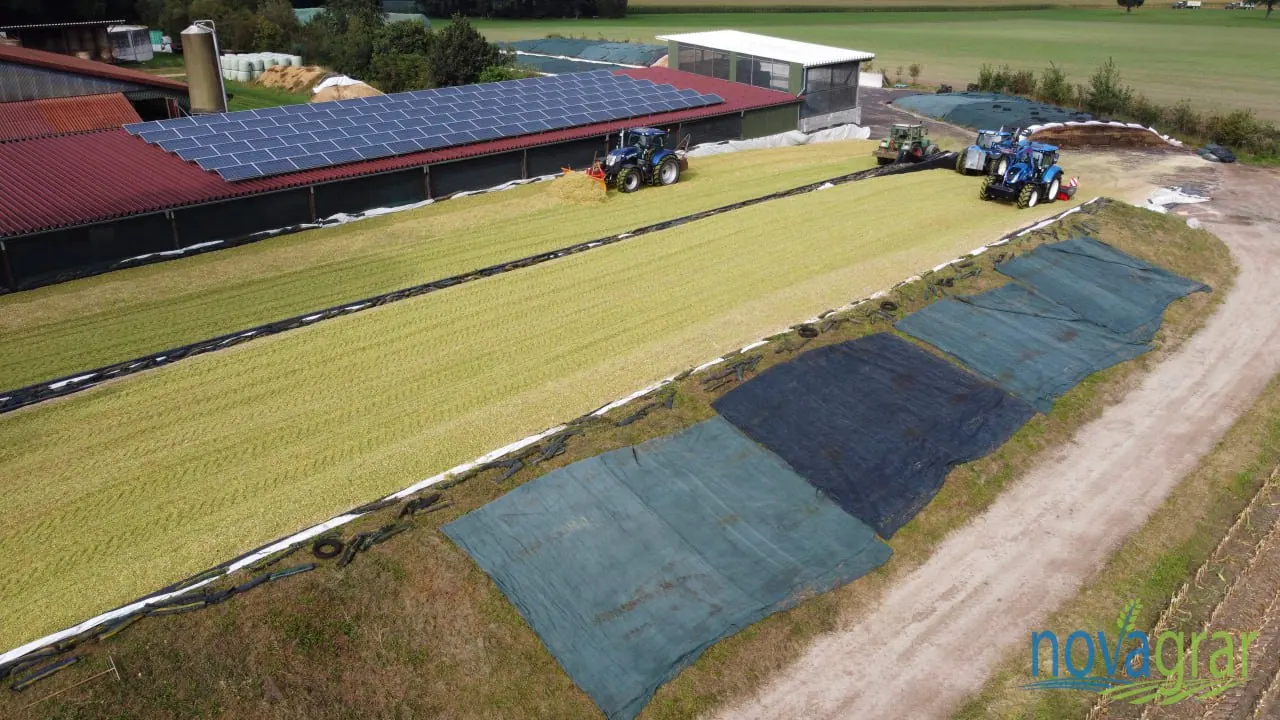
According to the DLG report, V12 Silver Cover uses 11 PE/EVOH layers, UV stabilisation and 80 μm nominal thickness. Novagrar states that the silver outer surface reflects solar radiation and that the integrated construction can replace a separate underlay film and reduce installation labour by up to 70%. These are manufacturer statements and must be assessed for the actual clamp.
What DLG actually measured
At a 0.2 bar pressure differential, DLG measured oxygen permeability of 2.0 cm³/(m²·day) for the film and 0.58 for the weld against a limit of 250. Mean thickness was 0.080 mm with a 0.072–0.086 mm range, and elongation at break exceeded 600% in all tested directions. Strength fell by 1.4% after acid storage, while elongation fell by 1.3% after accelerated weathering. DLG assessed laboratory mechanical, physical and chemical properties—not milk yield, farm economics or the feeding value of a specific silage.
- DLG: film — 2.0 cm³/(m²·day) at 0.2 bar.
- DLG: weld — 0.58 cm³/(m²·day).
- DLG limit — 250 cm³/(m²·day).
Why Novagrar and DLG figures differ
Novagrar quotes gas permeability below 0.5 cm³/(m²·24 h), while DLG measured 2.0 at 0.2 bar. This is not necessarily a contradiction because methods and conditions may differ. LabLog uses the measured DLG figure in the technical card and labels manufacturer data separately. Direct comparison requires identical methods.
Size the film to the clamp, not to a roll name
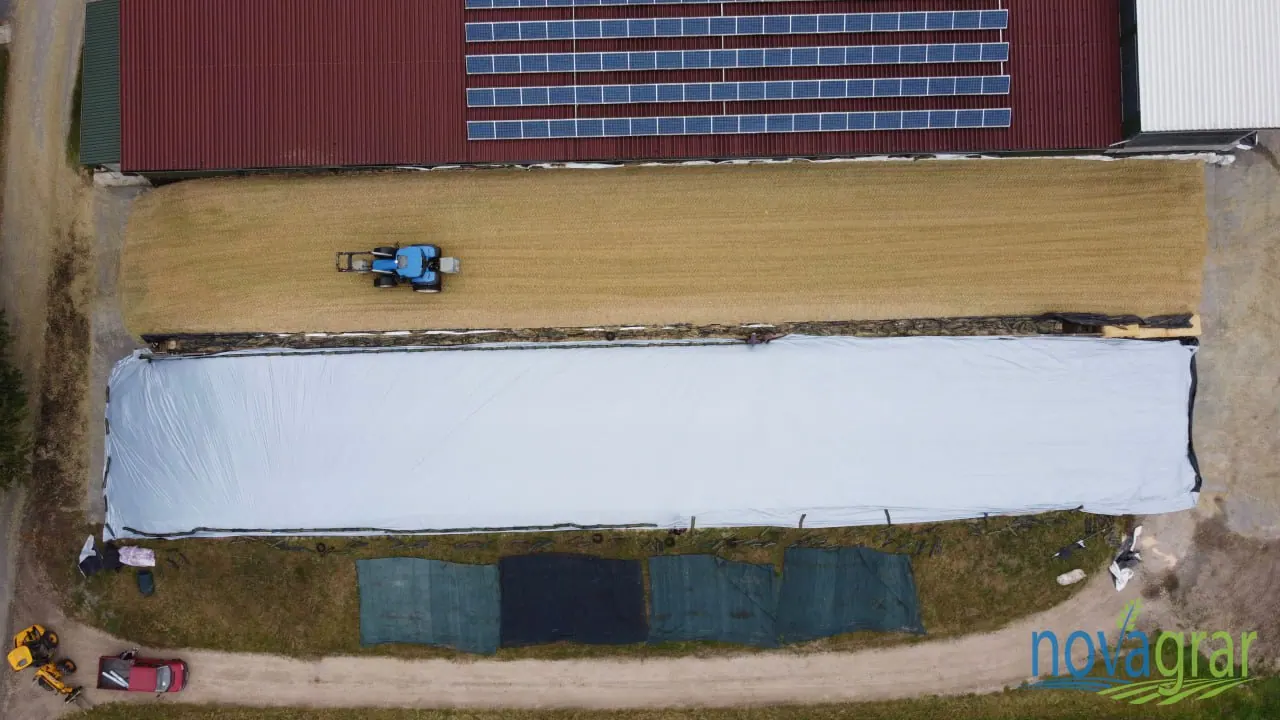
DLG lists lengths of 35, 50, 75, 150, 300 and 600 m. Standard widths run from 6–14 m in 1 m steps and 14–32 m in 2 m steps, with individual widths to 76 m. Novagrar currently states special formats up to 80 m wide and 1,500 m long. Sizing needs actual clamp length, width and profile, forage height, overlaps, edge allowance and anchoring method.
A practical covering sequence
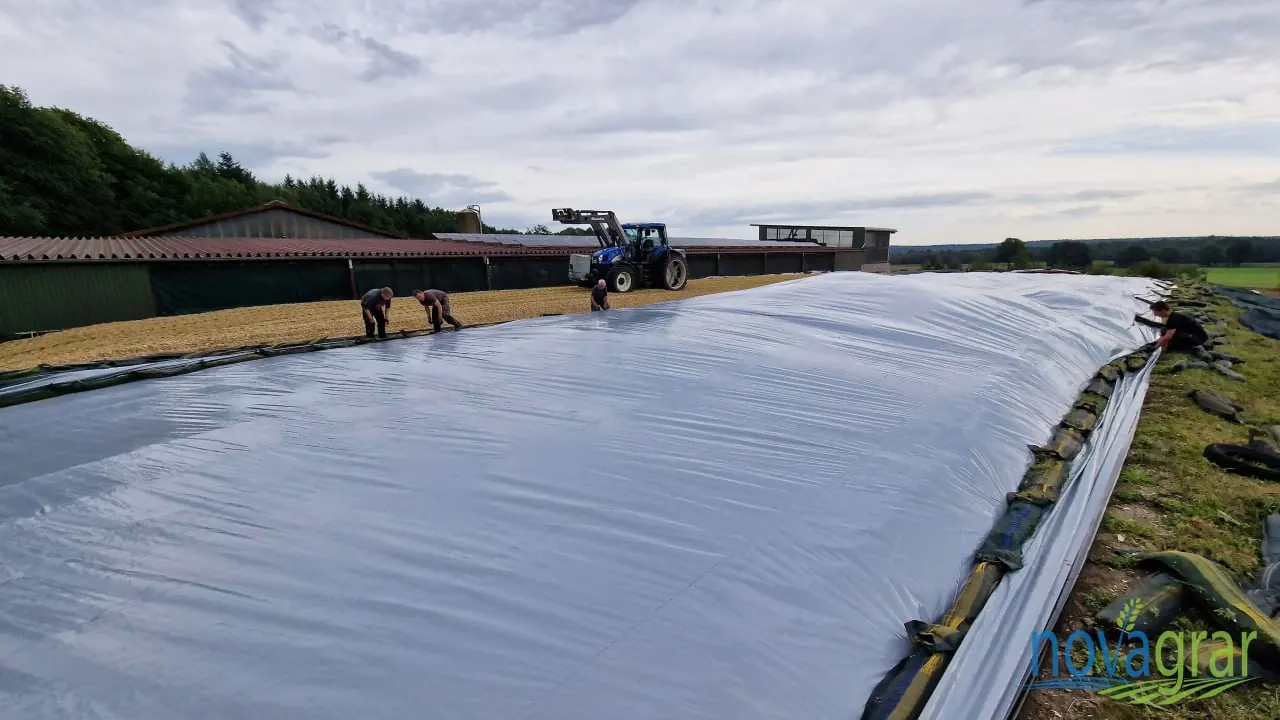
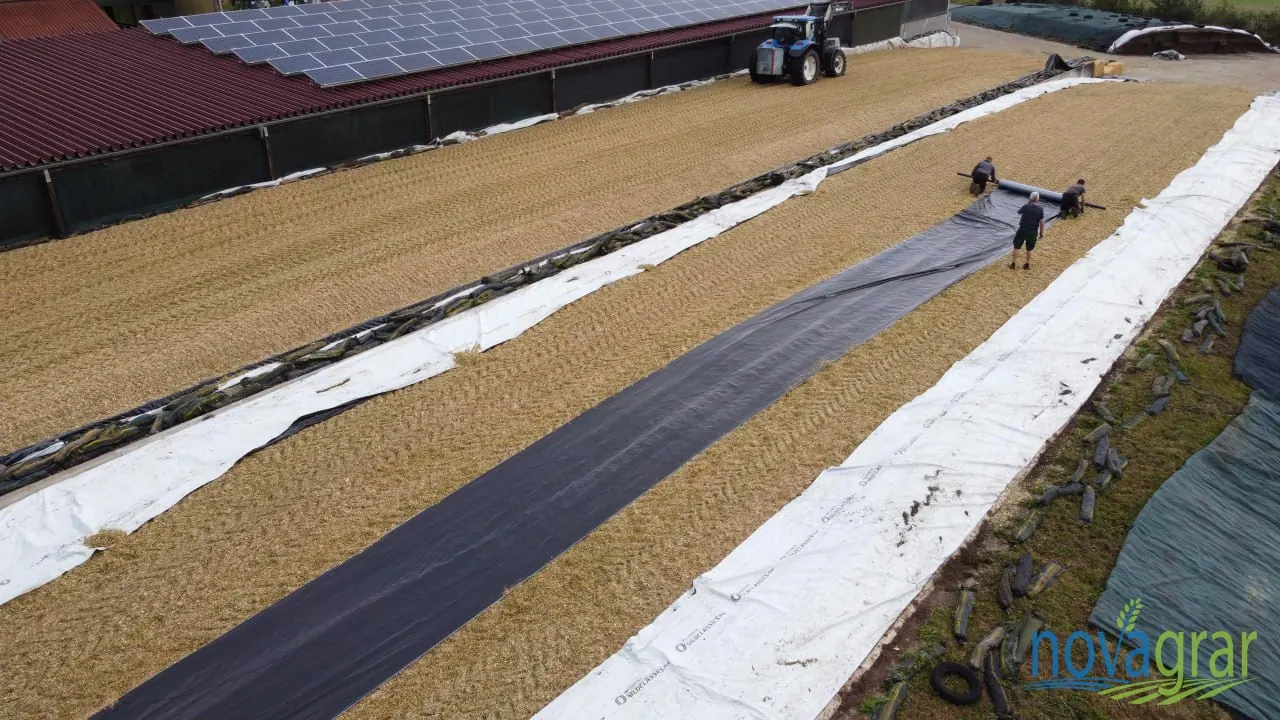
Cover immediately after filling and uniform compaction. Check the surface, remove sharp objects and deploy the film without dragging it over the ground or overstretching it. Seal overlaps, anchor edges evenly and repair punctures at once with compatible tape. Inspect again after wind, rain and nearby work.
What to prepare for a LabLog calculation
Send a plan or exact clamp dimensions, end and side photographs, expected volume, filling calendar, existing film and anchoring method, available machinery and previous problem areas. LabLog checks geometry, calculates useful area and overlaps, and specifies rolls and sealing materials. LabLog organises Novagrar supply to Uzbekistan; the final configuration is confirmed after reviewing the input data.
FAQ
FAQ
Does V12 replace an underlay and top film?+
Novagrar states that the integrated construction removes the need for a separate underlay. The final system must still match the clamp and anchoring method.
What does DLG 7416 prove?+
It reports selected laboratory mechanical, physical and chemical properties. It is not a field trial of silage quality or animal performance.
Can special sizes be ordered?+
Yes. Novagrar states special formats up to 80 m wide and 1,500 m long. Availability is confirmed for each order.
What should be done after a puncture?+
Clean and dry the area as far as possible and seal it immediately with compatible repair tape. Inspect the cover regularly.
Sources and documents