
Practical calf rearing
Calf rearing from birth to weaning: colostrum, feeding, housing and growth control
Calf-rearing results depend on a connected process rather than one machine: prompt and measurable colostrum feeding, a consistent milk mix, clean teats and lines, suitable housing, weight monitoring and data-based weaning. We compared the sixth Holm & Laue calf handbook with current manufacturer information and recent scientific reviews, separating useful principles from universal promises.
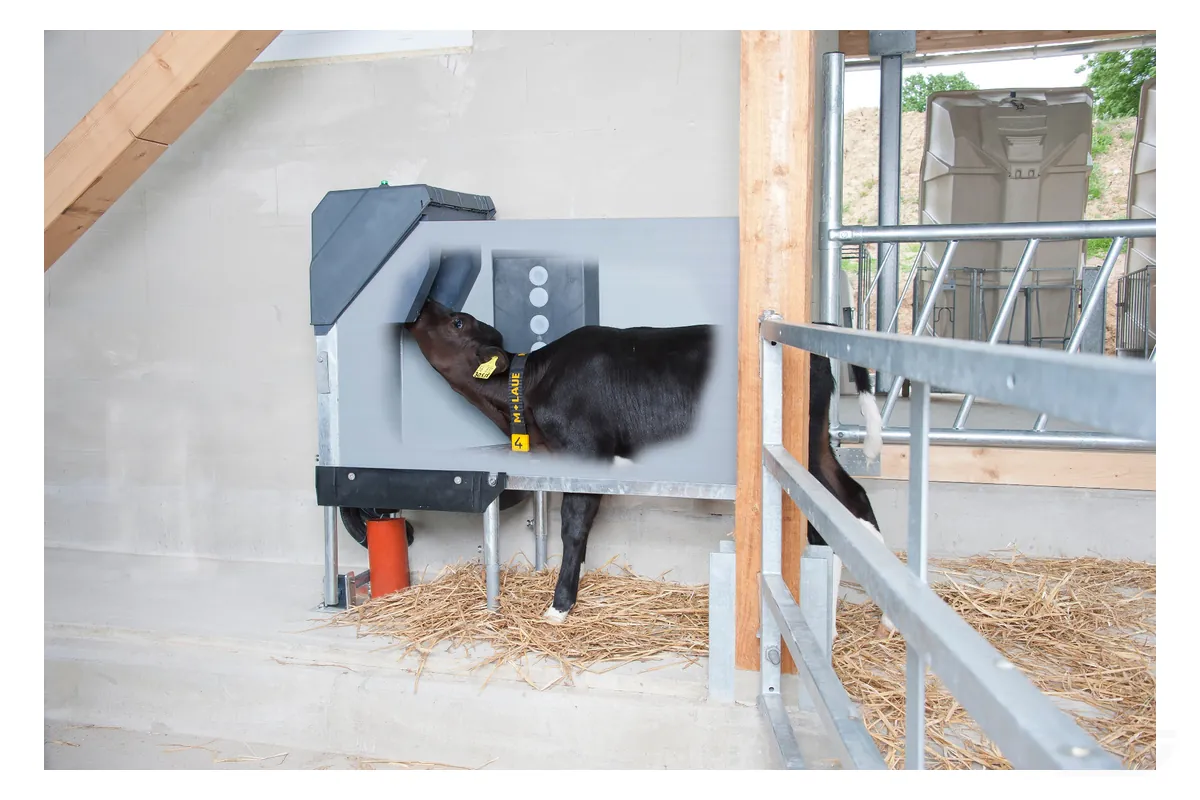

In short
1. Colostrum: manage the process rather than chance
The first feeding is time-critical because intestinal uptake of immunoglobulins declines rapidly after birth. Yet a single “feed four litres” rule is not a complete programme. A farm should know when the calf was fed, how much it received, how colostrum quality was assessed and how passive transfer was verified.
A Brix refractometer is practical for sorting colostrum and screening serum, but thresholds should be defined with the farm veterinarian and laboratory method. Current consensus recommends evaluating the herd across four passive-immunity categories, not only counting failures. A labelled colostrum bank and controlled thawing make the protocol repeatable even after an unplanned night calving.
- Record birth and first-feeding time
- Measure every stored colostrum batch
- Verify results at herd level, not from one calf
2. Milk feeding: consistency matters more than the largest number
A higher milk allowance can support stronger preweaning growth, but it should not become a universal litres-per-day target. Results depend on calf weight, whole-milk or replacer composition, dry-matter concentration, ambient temperature, health, water and starter access.
A higher milk allowance does not mean starter intake will remain unchanged. A recent systematic review found that in most preweaning studies, higher milk allowance was associated with lower starter intake, although calf growth was generally greater. Therefore an intensive programme needs accurate mixing, unrestricted water and starter, observation of faeces and appetite, and a gradual transition designed in advance.

3. Weaning: decide from development, not the calendar alone
Abruptly removing milk on a fixed day can create an energy gap and stress-related behaviour. A systematic review of 44 studies does not support early weaning as a universal goal and reports benefits from later or gradual approaches for several growth and intake outcomes. Science has not established one perfect starter-intake threshold for every farm.
A practical decision combines age, sustained starter and water intake, weight trend, health and behaviour. CalfExpert can implement gradual step-down curves, while MilkTaxi SmartID assigns a programme to a pen or calf. Equipment executes the rule; the farm technologist and veterinarian approve it from farm data.
4. Housing: fresh air without draughts and manageable groups
A hutch or calf barn should be judged by the calf’s resting zone rather than the system name: dry bedding, no direct draught, adequate air exchange, shade, drainage, cleanability and sufficient space. In Uzbekistan, heat load, direct sun, dust and water reliability must also be engineered.
The current Holm & Laue portfolio includes individual solutions, TwinHutch for pairs or mini-groups of two to three calves, the group Igloo for up to 15 calves, IglooVeranda and fixed IglooSystem layouts. They are not interchangeable: the choice depends on calving flow, grouping age, feeding programme, site, cleaning equipment and local veterinary requirements.
5. Weighing and CalfGuide: data for inspection, not an automatic diagnosis
Without repeat weighing, a farm sees milk use but not the outcome of its programme. WeightControl is available as the Base platform, Single mobile walk-through scale and Multi group transport scale. Records can be linked to electronic identification and transferred to CalfGuide.
CalfGuide combines MilkTaxi, CalfExpert and WeightControl data, presenting feeding and growth curves, attention lists and staff tasks. This can highlight deviations earlier and compare groups, but the software does not diagnose disease. An alert must lead to calf inspection and action under an approved protocol.

6. How to design the calf unit as one system
A specification starts with a flow map rather than a catalogue: weekly calvings, time in individual housing, group count and size, diet, milk source, wash points, water, power, drainage, staff routes and bedding removal. Only then should MilkTaxi, CalfExpert, milk supply, HygieneStation, hutches, scales and software be selected.
LabLog can gather the inputs, connect calf rearing to the whole-farm project, configure Holm & Laue and compatible portfolio solutions, and arrange supply, commissioning and training in Uzbekistan. Farm specialists approve the final feeding and health protocol; the manufacturer and supplier provide tools for consistent execution.
- Calf numbers and calving calendar
- Milk, replacer, water, cleaning and storage
- Groups, climate, drainage and staff routes
- Measurable outcomes: feeding, weight, health and labour
FAQ
FAQ
Is “four litres of colostrum in the first hour” enough as a rule?+
It is a useful guide, but a complete protocol also records timing, quality, actual volume, hygiene, storage and passive-transfer outcome. The herd veterinarian approves the farm-specific target.
Should calves receive as much milk as possible?+
There is no universal volume. Higher allowance can improve growth but requires accurate composition, health control, water, starter and a planned weaning transition. The programme is designed for the animals and farm conditions.
When should a calf be weaned from milk?+
Use a combination of age, sustained dry-feed and water intake, weight trend, health and behaviour. Abrupt early milk removal should not be a goal in itself.
Does CalfGuide diagnose disease?+
No. It combines data and creates attention lists. Diagnosis and treatment remain the veterinarian’s responsibility after examining the calf.
Can outdoor housing work in Uzbekistan’s hot climate?+
Only after designing shade, orientation, ventilation, water, drainage and dust protection. A European layout should not be copied without climate adaptation.
Sources and documents
- Holm & Laue — calf-rearing resources and handbook
- Holm & Laue — NativeCalfConcept
- Holm & Laue — CalfGuide
- Holm & Laue — WeightControl
- Holm & Laue — group Igloo
- Holm & Laue — TwinHutch
- Consensus on passive immunity in dairy calves, JDS 2020
- Systematic review of milk feeding practices, JDS 2023
- Systematic review of weaning practices, JDS 2024