
Milk filtration
MILKFOR milk filters: choosing a filtration stage for a farm or dairy plant
A milk filter is selected by contamination type, temperature, line capacity and installation point. Its job is to retain mechanical contamination and protect the next process stage. It cannot automatically make problematic milk compliant and does not replace veterinary work, laboratory testing or equipment cleaning.

In short
Start by locating the contamination source
Milk may contain visible debris, fine particles, mastitis clots and deposits from equipment. Before selecting a filter, review udder, milking-system, pipeline and tank hygiene. Filtration is a control stage, not a substitute for removing the cause.
If an element clogs quickly or tears, opening the pore size is not enough. Check flow, pressure, temperature, filtration area and contamination source, otherwise the problem merely moves downstream.
Slot filter: preliminary filtration
The MILKFOR slot filter is installed upstream of a polypropylene fine-filter element. It retains larger debris and reduces the load on the disposable filter. This stage is useful when straw, hair or other particles rapidly block a sleeve element.
A pre-filter does not eliminate fine filtration or correct poor pre-milking hygiene. The element and capacity must match the actual line.
Base and Argentum Ag+: fine filtration
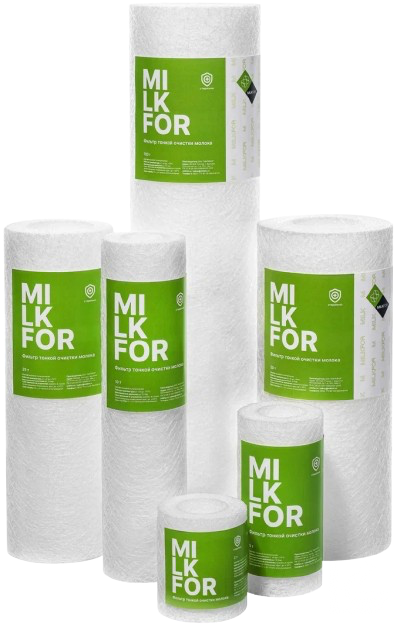
Base is a replaceable polypropylene element for mechanical filtration. The manufacturer positions Argentum Ag+ as a version with a silver-containing component. This must not become a promise to disinfect an entire batch: performance depends on configuration, contact, flow and verified conditions.
Geometry, capacity and replacement rules matter in daily use. Inspect a spent disposable element as a process indicator, record unusual contamination and discard it according to procedure; do not wash it for reuse.
Somatic: no universal promises
MILKFOR publishes a production case where measured average SCC decreased after Somatic was introduced. This is a site-specific result, not a guarantee for every farm. Somatic cells remain an udder-health indicator; persistently high SCC requires identification of affected cows plus mastitis, milking and hygiene controls.
Somatic can be considered a filtration element, not a treatment or a way to bypass raw-milk testing. Comparable laboratory measurements before and after implementation and a veterinary action plan are required.
How LabLog selects the system
First document the product, installation point, temperature, peak flow, pressure, existing housing and observed contamination. Then agree filtration stages, dimensions, spare elements and inspection frequency.
Assess a trial over several shifts: pressure behaviour, element integrity, retained debris, laboratory data and absence of adverse process effects. Compatibility and expected performance are site-specific.
- Temperature, flow, pressure and cycle duration
- Housing and current element dimensions
- Spent-filter photos over several shifts
- Laboratory acceptance criterion
What filtration does not replace
Filtration does not replace udder preparation, a sound milking system, CIP, cooling, antibiotic tests, somatic cell counting or microbiological control. Reliable quality requires these measures to work together.
FAQ
FAQ
Which MILKFOR filter should be selected?+
It depends on installation point, temperature, flow and contamination. Larger debris may require a slot stage followed by a correctly sized replaceable element.
Does the Somatic filter treat mastitis?+
No. The manufacturer reports a site-specific change in measured SCC, but high SCC remains a signal for veterinary investigation and correction of housing, milking and hygiene.
Can a disposable filter be reused?+
No. Use and replace it according to the manufacturer procedure. Washing and reuse create risks of damage and cross-contamination.
What information is needed for selection?+
Product type, temperature, flow, pressure, installation point, housing dimensions, current-filter photos and a description of the problem.
Sources and documents