
Science and practice
California Mastitis Test: what CMT shows and how to interpret it
The California Mastitis Test is a rapid cow-side screening method that compares milk from all four udder quarters. Its value is not that it replaces the laboratory, but that it shows within seconds where repeat testing and more precise diagnostics are needed.


In short
Why the mixture thickens
The detergent in the reagent disrupts somatic-cell membranes. Released cellular material, including DNA, increases the mixture’s viscosity. The operator scores the transition from a liquid reaction without streaks to a pronounced gel. CMT is therefore related to cell count, but cell composition also matters: at the same total count, different proportions of neutrophils and macrophages can produce different viscosity.
Relating the reaction to somatic cell content
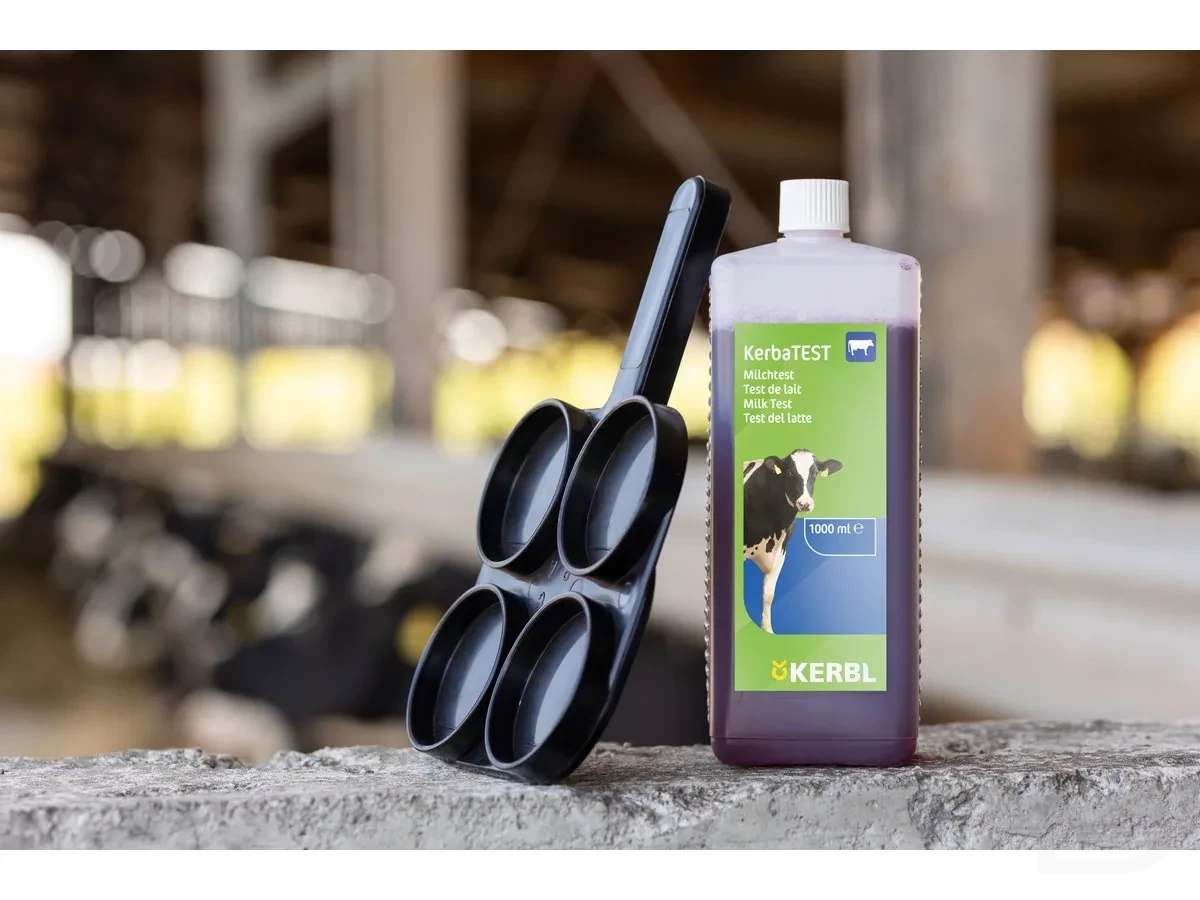
KERBL’s instructions divide the reaction into four approximate levels: a liquid mixture without streaks indicates a low category; slight streaking is transitional; marked thickening and gel formation indicate an elevated category; a firm gel indicates a very high category. These bands are estimates rather than exact cell counts. Studies show that CMT sensitivity and specificity change with the selected cut-off, lactation stage, unit of analysis—cow or quarter—and the population tested.
- Always compare all four quarters of the same cow.
- Use equal volumes of milk and reagent.
- Read immediately using one consistent scoring scale.
What can distort the result
The first milk streams contain more cells and bacteria, so they are discarded before sampling. Colostrum, early or late lactation, recent calving, visible milk changes, unequal volumes, overly vigorous mixing or delayed reading can alter interpretation. A single weak-positive result should be repeated under comparable conditions.
Why CMT should not be treated as a diagnosis
Elevated somatic cell content points to inflammation but does not identify a microorganism or its antimicrobial susceptibility. Research explicitly cautions against treatment decisions based on CMT alone. A sound workflow is to repeat the test, clinically assess the cow and milk, obtain an exact cell count and, where needed, submit a sample for bacteriology or another confirmatory method.
Where KERBATEST fits in a control programme
KERBATEST is particularly useful as a rapid, practical screening tool: checking a cow after a change in yield or conductivity, monitoring quarter-level changes under a veterinary protocol, selecting a laboratory sample or observing an at-risk group. Its value increases when the result is recorded by cow and quarter, linked to lactation stage and followed by confirmation rather than left as a one-off visual impression.
FAQ
FAQ
What somatic-cell threshold does CMT detect?+
There is no single universal threshold for every lactation stage and setting. The reaction is assigned to an approximate category and interpreted alongside the cow’s history, other quarters and a confirmatory method.
Can CMT be used to select an antibiotic?+
No. CMT does not identify the pathogen or susceptibility. Therapy is a veterinary decision made after clinical assessment and the necessary confirmatory tests.
When should the test be performed?+
Before the main milking, after discarding the first three streams and before milk from different quarters is mixed.
Sources and documents