
Reference analysis
The Kjeldahl method: nitrogen and protein determination, standards and the FOSS Kjeltec 9 workflow
The Kjeldahl method measures total nitrogen and converts it to protein with a factor selected for the product. A defensible result therefore depends on the full chain: preparation and digestion, steam distillation, titration, calculation and quality control.

In short
How a brewing problem became a global reference method
In 1883 Johan Kjeldahl, head of chemistry at the Carlsberg Laboratory in Copenhagen, published a new method for nitrogen determination in organic substances. His practical problem concerned barley protein during malting and its effect on beer quality.
Catalysts and potassium sulphate later accelerated digestion, while boric acid simplified ammonia collection. The core logic remains: convert organic nitrogen into a measurable form and quantify it by titration. Today the principle is embedded in industry standards and supports verification of rapid NIR and FTIR methods.
What the method measures: nitrogen, not protein directly
The analytical result is first obtained as a nitrogen mass fraction. Protein is calculated as Protein (%) = Nitrogen (%) × F, where F is the conversion factor prescribed by the standard or accepted method for the matrix. A common general factor is 6.25; 6.38 is widely used for dairy and 5.70 for wheat.
The factor must not be selected simply to obtain a convenient result. The report should identify the standard, sample type and factor used. Kjeldahl also includes non-protein nitrogen, so “crude protein” is often the more precise term unless the standard defines otherwise.
- General factor: 6.25
- Milk and dairy products: commonly 6.38
- Wheat and wheat products: commonly 5.70
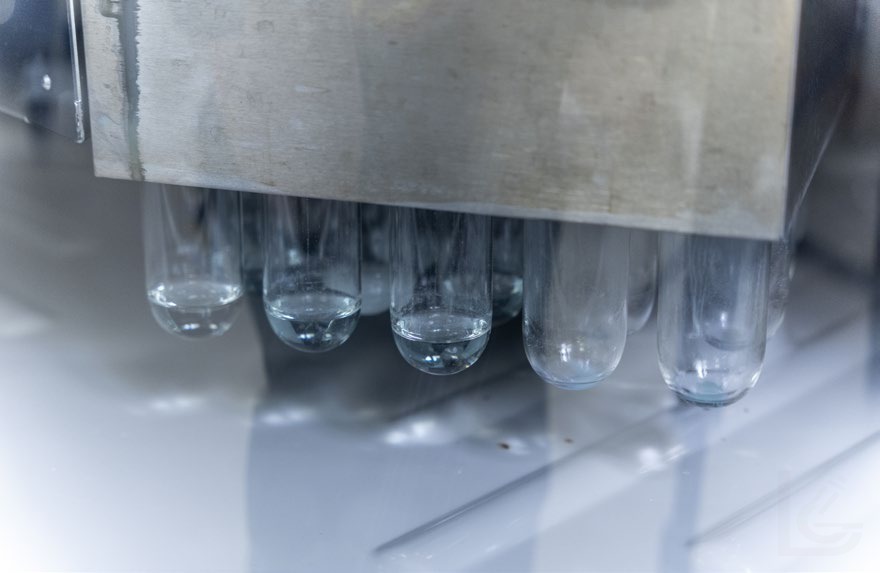
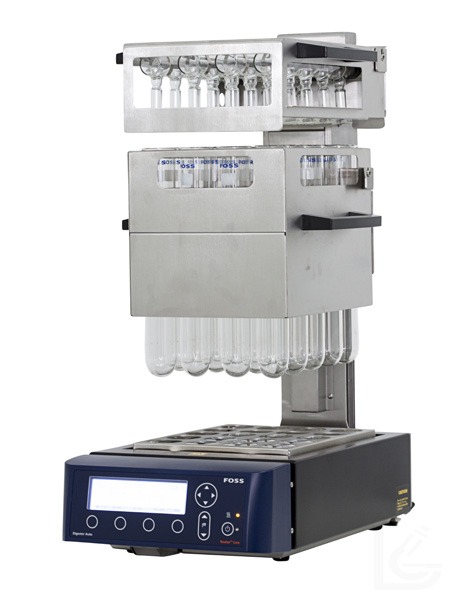
Stage 1. Sample digestion in a Digestor
The test portion is heated with concentrated H₂SO₄ in the presence of a catalyst and K₂SO₄. The organic matrix is destroyed; carbon is mainly converted to CO₂, hydrogen to H₂O and organic nitrogen to ammonium, usually represented as (NH₄)₂SO₄ in solution. Simplified: organic N + H₂SO₄ → (NH₄)₂SO₄ + CO₂ + H₂O.
Kjeltec 9 does not perform this stage. A separate Digestor is required: manual DT 208/220 blocks for 8 or 20 tubes, or automated Digestor 2508/2520 units. Corrosive fumes require the matching exhaust manifold and consideration of a scrubber, together with a fume hood and an appropriate safety procedure.
Stage 2. Ammonia release and steam distillation
After digestion the solution is made alkaline with NaOH. Ammonium is converted to volatile ammonia: NH₄⁺ + OH⁻ → NH₃↑ + H₂O. For ammonium sulphate, the molecular form is (NH₄)₂SO₄ + 2NaOH → 2NH₃↑ + Na₂SO₄ + 2H₂O.
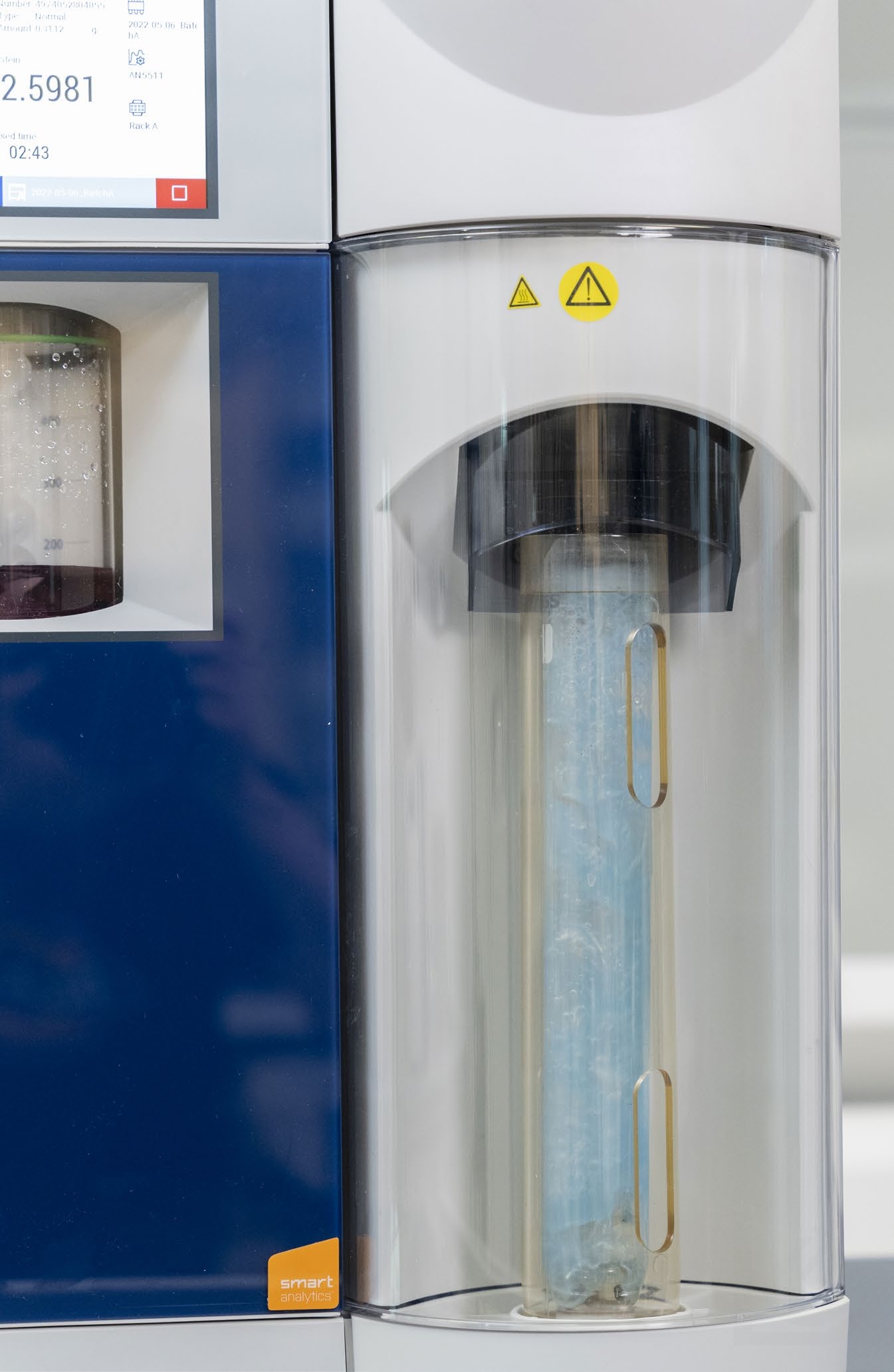
Steam carries the ammonia into a boric-acid receiving solution. Kjeltec 9 controls reagent addition and distillation; the SAfE mode helps reduce the risk of a violent reaction with difficult samples. The exact programme must follow the approved method and expected nitrogen level.
Stage 3. Colorimetric titration and calculation
Ammonia captured in the receiving solution is titrated with a standardised acid to the endpoint. With hydrochloric acid the simplified reaction is NH₃ + HCl → NH₄Cl. Titrant volume and concentration, corrected by the blank, provide the nitrogen amount. In general: N (%) = ((V − V₀) × c × 14.007 × 100) / (m × 1000), where V and V₀ are sample and blank titrant volumes, c is molarity and m is the test portion in grams. Protein is Protein (%) = N (%) × F.
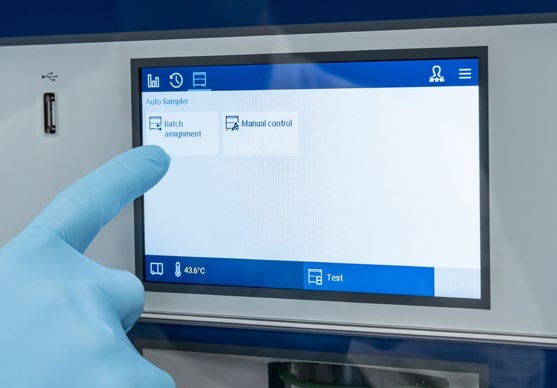
Kjeltec 9 Analyser uses built-in colorimetric titration, automatic LED calibration and automatic endpoint-colour setting. Automation reduces manual operations but does not replace titrant standardisation, blanks, control materials or periodic nitrogen-recovery checks.
Applicable standards: select by product matrix
There is no single universal standard number for every product. The method and protein factor must be selected for the matrix, the scope of the standard and the laboratory procedure. Relevant CIS standards include GOST 23327-98 and GOST 34454-2018 for milk, GOST 25011-2017 for meat, GOST 10846-91 for grain and GOST 13496.4-2019 for feed. International references include ISO 8968-1 / IDF 20-1 for dairy and ISO 937 for meat.
Before implementation, the laboratory must verify the current edition, scope, sampling and preparation rules, permitted reagents, blank correction, accuracy control and reporting format. Owning a Kjeltec does not by itself create compliance: compliance belongs to the complete validated procedure.
- Dairy: GOST 23327-98; GOST 34454-2018; ISO 8968-1 / IDF 20-1
- Meat: GOST 25011-2017; ISO 937
- Grain: GOST 10846-91
- Feed: GOST 13496.4-2019; AOAC 2001.11
FOSS Kjeltec 9 Kjeldahl analyser: three configurations
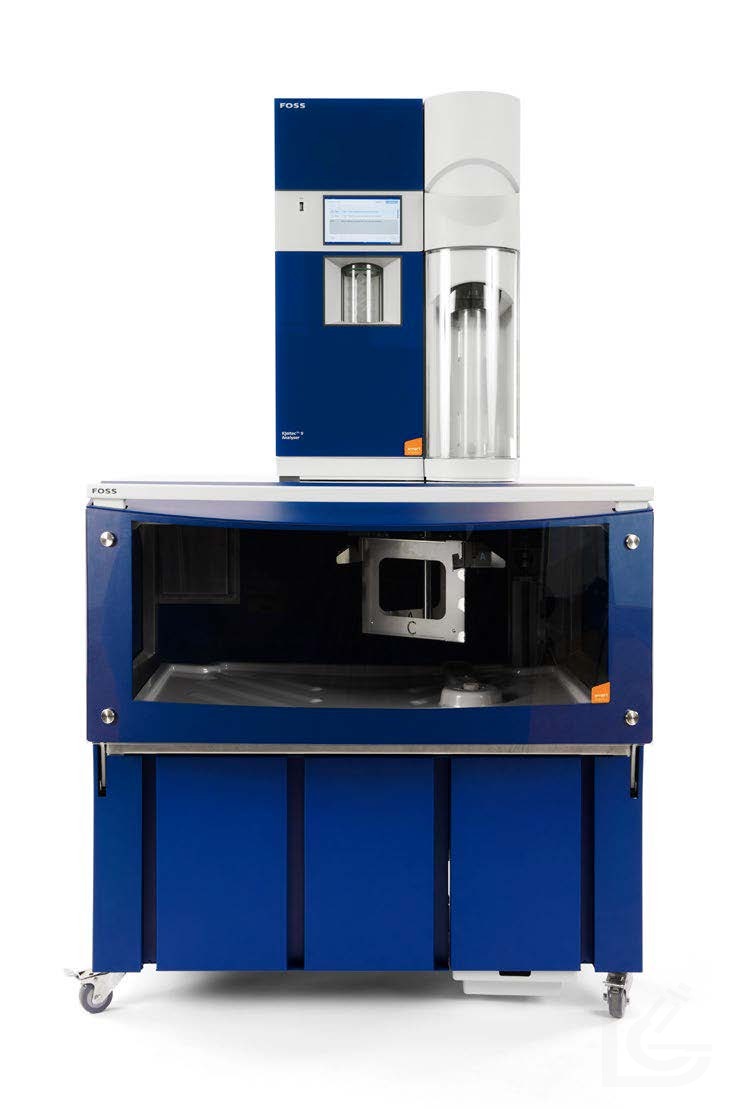
Kjeltec 9 Distillator performs steam distillation and can work with an external titrator. Kjeltec 9 Analyser adds built-in colorimetric titration and automatic calculation. Analyser with Autosampler accepts 20 or 60 samples for batch work. FOSS states up to 240 samples per 24 hours and more than four hours of unattended operation with the autosampler.
For Kjeltec 9 Analyser, FOSS specifies a 0.1–210 mg N range, 3.5 minutes at 30 mg N and 6.5 minutes at 200 mg N, with recovery above 99.5% for 1–200 mg N. These are manufacturer specifications under stated conditions and do not replace performance verification for the laboratory matrix.
How to configure the complete method
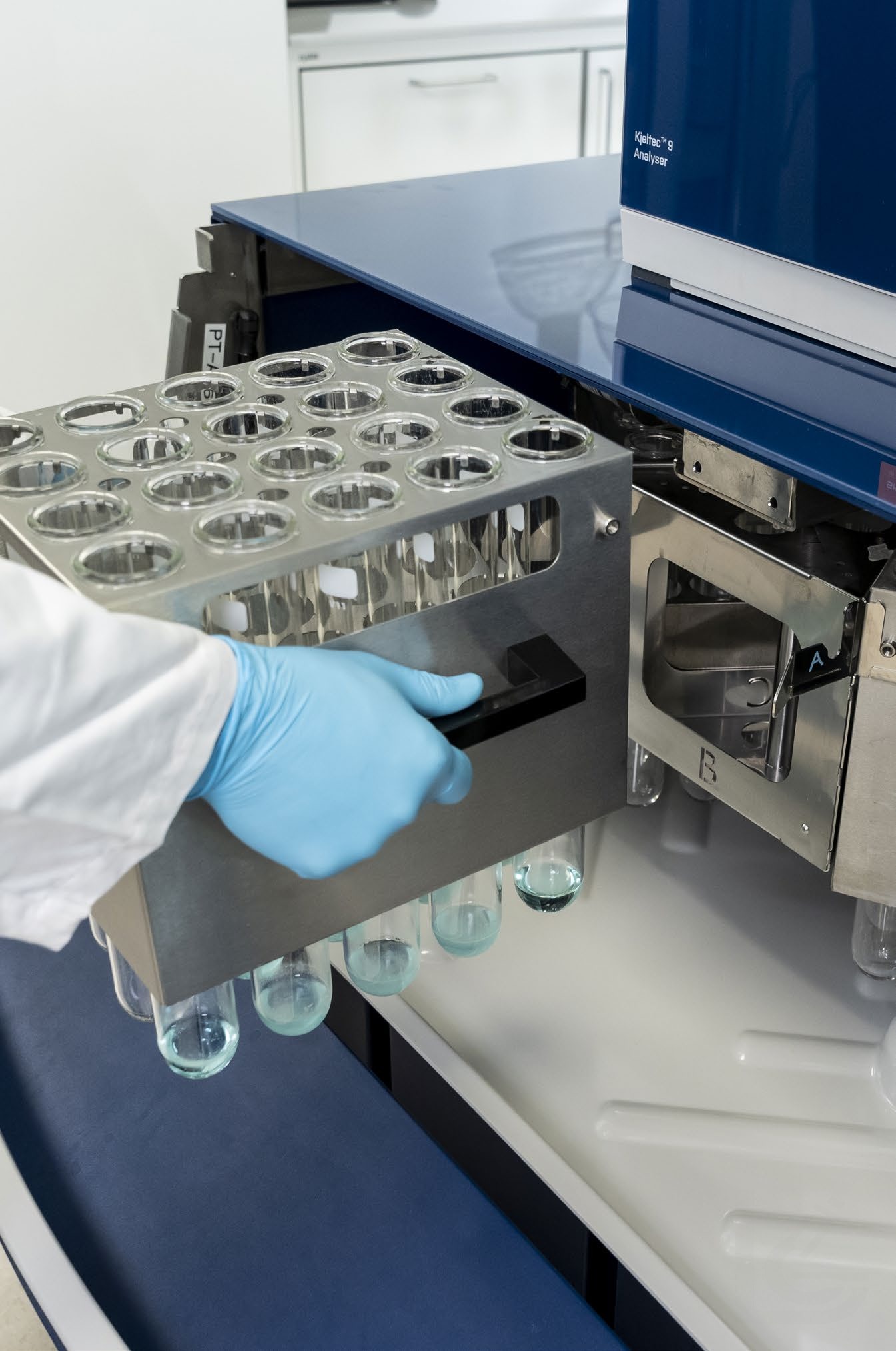
A working system has at least two process modules: digestion in a Digestor and distillation/titration in Kjeltec. The digestion block needs racks and tubes, an exhaust manifold and a fume-removal or neutralisation solution. The analyser requires reagent vessels, reagents, burette and consumables; an autosampler is added for higher throughput.
For lower throughput, DT 208/220 with Kjeltec 9 Distillator or Analyser is a practical setup. Medium and high throughput favours Digestor 2508/2520 with Kjeltec 9 Analyser, optionally with a 20- or 60-sample autosampler. LabLog clarifies matrices, standards, sample flow, utilities and traceability needs, then configures supply, consumables, commissioning and training for projects in Uzbekistan.
FAQ
FAQ
What does the Kjeldahl method determine?+
It determines total nitrogen. Protein is calculated by multiplying nitrogen mass fraction by the factor specified for the product and method.
Does Kjeltec 9 digest the sample?+
No. Acid digestion is performed separately in a Digestor. Kjeltec 9 performs steam distillation, while the Analyser version also provides built-in titration and calculation.
Which standard applies to Kjeldahl protein?+
It depends on the product: examples include GOST 23327-98 and 34454-2018 for dairy, GOST 25011-2017 for meat, GOST 10846-91 for grain and GOST 13496.4-2019 for feed. Scope and current edition must be checked.
How does Kjeltec 9 Analyser differ from Distillator?+
Distillator automates distillation and can work with an external titrator. Analyser adds built-in colorimetric titration and automatic calculation.
Can Kjeltec support NIR and FTIR calibration?+
Yes. Results from an approved reference procedure support development and verification of rapid-method calibrations. Sample preparation, representative ranges and statistical validation remain essential.
Where can a complete Kjeltec 9 system be ordered in Uzbekistan?+
LabLog Group helps configure and officially supply Kjeltec 9, a Digestor, fume-handling equipment, consumables and accessories in Uzbekistan. The final setup follows the matrices, applicable standards and sample throughput.
Sources and documents
Next step
LabLog will help assemble a complete Kjeldahl system
The Kjeldahl method is reliable only when the full workflow is aligned: sample preparation, digestion, fume removal, distillation, titration and calculation. Choosing one instrument separately from the method, standard and actual sample load creates avoidable laboratory risk.
Tell us which products you analyse and how many samples you process per shift. The LabLog team will match the task to the applicable standards and select a compatible FOSS system — from Digestor and Scrubber to Kjeltec 9, accessories and consumables.
- Define matrices, standards and required throughput
- Build a compatible configuration without unnecessary equipment
- Plan commissioning, training, consumables and support
The form request is delivered to the LabLog team in Telegram. We will contact you to clarify the technical task.