
Milk control
SomaticScan: how to count somatic cells in milk
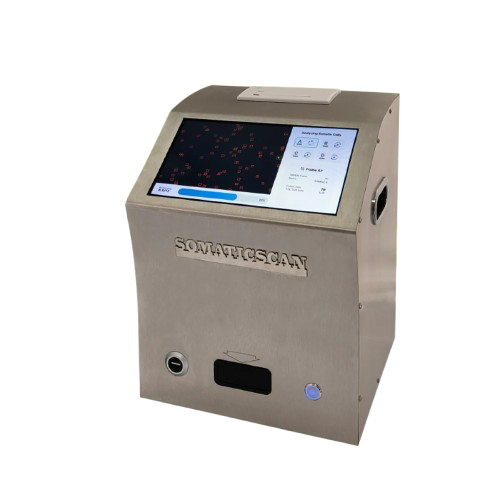
SomaticScan is an automatic somatic cell counter for raw cow and buffalo milk. It stains cell nuclei with a fluorescent dye, captures microscopic images and counts qualifying objects by software. This is direct optical counting, not indirect viscosity estimation and not flow cytometry. It supports milk control and flags samples that need attention, but it does not diagnose mastitis by itself: a specialist must interpret the result with clinical signs, animal history and the farm protocol.

In short
What SCC shows and why it is monitored
SCC is the number of somatic cells in one millilitre of milk. Milk contains epithelial and immune cells, and their number commonly rises during inflammation. SCC is therefore used as an udder-health and raw-milk quality indicator for individual animals, groups and bulk tanks. There is no single threshold for every decision: the limit depends on sample type, local requirements and the farm protocol. One result, its repeat, the trend and supporting information all matter.
How fluorescence microscopy works
The operator mixes 100 µl of milk with dry fluorescent dye. After the dye hydrates, 8 µl of stained sample is loaded into a disposable microfluidic chip channel. The instrument focuses automatically, illuminates the preparation and records 12 fields in every selected channel. Its algorithm recognises the fluorescent cell signal, excludes small fragments and atypical artefacts, then converts the count to cells/ml. This reduces the subjectivity of manual counting, although result quality still depends on a representative sample and correct procedure.
Workflow: from milk to result
One Somaticchip has four independent channels, A–D. The dye needs 30–60 seconds to hydrate. After filling the chip, allow the sample to spread through the channel; the manual recommends starting no earlier than one minute after loading and not waiting longer than 4–5 minutes, to reduce evaporation and air-bubble risk.
- mix milk without foaming and label the sample
- add 100 µl to the dye tube and wait 30–60 seconds
- mix on MiniVortex and load 8 µl into each required channel
- insert the chip, enter identifiers and start scanning
Range, throughput and interpretation
The range is 10,000 to 10,000,000 cells/ml without dilution. Stated throughput is up to 130 samples per hour when four-channel chip preparation is organised as a flow. The screen provides the result, image and mean size of recognised cells; data can be printed and exported. Colour zones are configured for local limits or an internal protocol: factory colours should not replace the site’s approved criteria. Elevated SCC is a signal for investigation, not a diagnosis by itself.
What most often distorts the result
The main risk is an unrepresentative sample. Cells distribute unevenly during storage, so milk must be mixed again. The manual allows refrigerated storage for no more than 48 hours at up to 5°C, while warning that some cells degrade over time and reliability falls. A contaminated chip surface, touching the channels, bubbles, incomplete dye dissolution, incorrect pipette volume and delayed scanning after loading can also compromise a measurement.
Direct counting and indirect screening are not the same
Viscometric tests estimate SCC indirectly from viscosity changes after a reaction. SomaticScan visualises stained cell nuclei and counts them in images. The current ISO 13366-2:2006 describes operating conditions for fluoro-opto-electronic counters, while ISO is developing a new edition focused on flow cytometry. SomaticScan is not a flow cytometer, and sharing fluorescence-staining principles does not automatically establish compliance or reference-method status—those claims require separate validation of the specific system and procedure.
Consumables and the real cost per test
The starter kit covers 100 tests: 25 four-channel Somaticchips, 100 tubes with lyophilised dye, 200 tips, containers, stands and air filters. Routine operation requires advance consumable-stock control. Cost per result depends not only on kit price but also on filling all four channels, repeats and rejected preparations. LabLog stocks replacement kits in Uzbekistan and helps estimate demand from the actual sample flow.
SomaticScan or SomaticScan Combo
Choose SomaticScan for rapid SCC. SomaticScan Combo combines the same fluorescence-microscopy module with an ultrasonic milk-composition analyser for fat, SNF, density, protein, lactose and other parameters. The modules use different methods and sample volumes; Combo does not remove the need for correct SCC-chip preparation or composition-module calibration verification. For simpler standalone composition control consider MilkoTester Lite; for a deeper dairy-plant laboratory, consider FOSS MilkoScan Mars or FT3.
LabLog supply, training and service
LabLog Group is an authorised Dairy Analysis B.V. distributor in Uzbekistan for the sale, installation, commissioning, service and support of SomaticScan, SomaticScan Combo and milk analysers. We select the model for the task and sample flow, supply the starter kit, configure interpretation limits, train staff in sampling and preparation, and provide warranty and post-warranty service. Before purchase, customers can bring samples to the LabLog showroom in Tashkent and run the workflow with a specialist.
FAQ
FAQ
Does SomaticScan diagnose mastitis?+
No. It counts somatic cells and helps flag a sample with elevated SCC. A veterinarian makes the diagnosis and animal-level decision using clinical signs, repeat results and the farm protocol.
Must milk be diluted?+
No. In the 10,000–10,000,000 cells/ml range, 100 µl of original milk is mixed with dry dye and 8 µl of prepared sample is loaded into the channel.
How many samples fit on one chip?+
Four. Somaticchip has independent A, B, C and D channels. All four can be analysed, or empty channels can be disabled.
Does SCC require user calibration?+
It is not required for routine operation. The procedure should still be checked with control samples, and standards compliance or reference-method status requires separate validation.
What is in the starter kit?+
Consumables for 100 tests: 25 four-channel chips, 100 dye tubes, 200 tips, containers, stands and air filters. LabLog confirms exact contents in the specification.
Sources and documents