
Food laboratory equipment
KERN for food production: balances, moisture analysers, refractometers and microscopes
A food plant should not select a balance by maximum capacity alone, or a refractometer simply because it displays Brix. Intake, formulation, filling, moisture control and microscopy require different ranges, readability, surfaces, protection and result-verification procedures. This guide maps KERN as one measurement chain, from laboratory samples to floor platforms.

In short
KERN & SOHN: measurement technology since 1844
KERN & SOHN is an independent family-owned company based in Balingen, Germany. The KERN brand dates to 1844, and the manufacturer describes itself as Germany’s oldest precision-balance factory. Its current portfolio includes laboratory and industrial balances, test weights, moisture analysers, refractometers, microscopes, software and calibration services.
For a food producer, the value is not the number of catalogue items but the ability to configure connected operations within one measurement portfolio: sample weighing and formulation, mass control, moisture assessment, refractometry and visual inspection. The final model still has to match the matrix, range, accuracy, cleaning, documentation and metrology requirements of the project in Uzbekistan.
How to select a balance: the task matters more than one accuracy figure
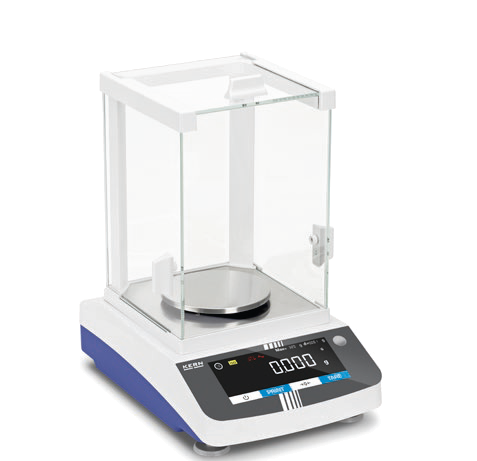
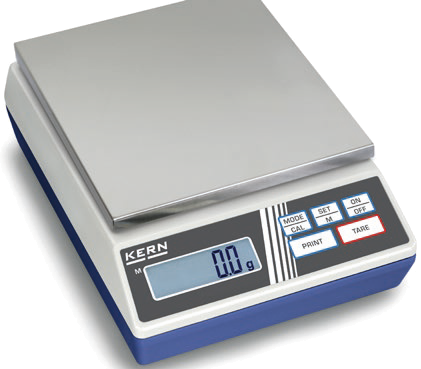
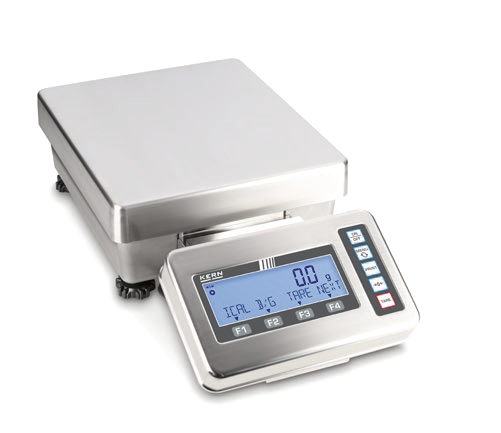
Analytical or precision balances are used for small samples and laboratory preparation. Formulation, portion control and filling require a higher capacity, suitable platform and functions such as check or percentage weighing. KERN 440 supports percentage determination; PDS/PDT and FES/FEJ address more demanding laboratory and formulation work, while ABP/ADT cover analytical weighing.
Selection starts with minimum and maximum load, permitted uncertainty, container size, internal adjustment, interfaces and result-recording needs. Display readability does not automatically equal the permissible error of the complete method. Where legal metrology applies, the required version and conformity procedure for Uzbekistan must be confirmed before ordering.
- KERN 440: compact laboratory and percentage weighing
- PDS/PDT and FES/FEJ: precision series for formulation and control
- ABP/ADT: analytical series for 0.1 mg or 0.01 mg-level work
Production floor: stainless steel, platform and floor scales
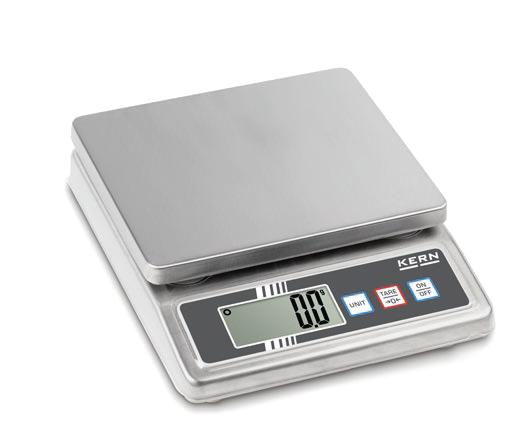
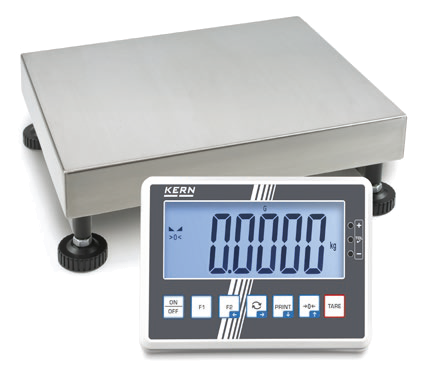
In raw-material and finished-product areas, housing, platform and cleaning method can matter more than an extra decimal place. Compact KERN FOB-S models support weighing, checking and portioning in limited space. IFC platform scales offer a larger work surface and interface options. BID floor scales are intended for heavier containers and loads; the brochure specifies an anti-slip chequered platform and four alloy-steel, silicone-coated IP67 load cells.
Protection for one component must not be assumed for the complete system. A washdown review should separately cover the indicator, cables, connectors, load cells, drainage and cleaning chemistry. CUSOS customised platforms are considered when geometry, restraint or the weighing workflow does not fit a standard configuration.
Refractometers: Brix, refractive index and salt
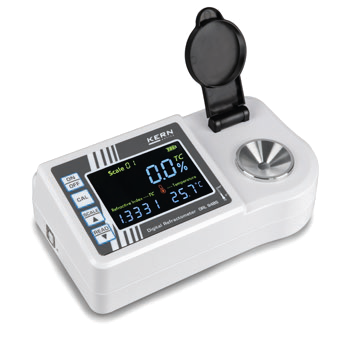
The analogue ORA 32BA covers 0–32% Brix for rapid checks of sugar-containing solutions. The digital ORM 50BM covers 0–50% Brix and refractive index from 1.3330 to 1.4200 nD. The ORL 94BS benchtop instrument covers 0–94% Brix and 1.3330–1.5290 nD; the food-specific ORL 94LM adds preset scales for selected sugars and salt.
Brix is an optical property of a solution, not a universal direct sugar assay for every complex matrix. Organic acids, salts, alcohol and other dissolved components also affect the result. The scale, temperature, sample preparation and comparison method must therefore be defined for the actual product, whether juice, syrup, honey, brine, beverage or dairy ingredient.
Moisture analysers: fast, but only with a validated programme
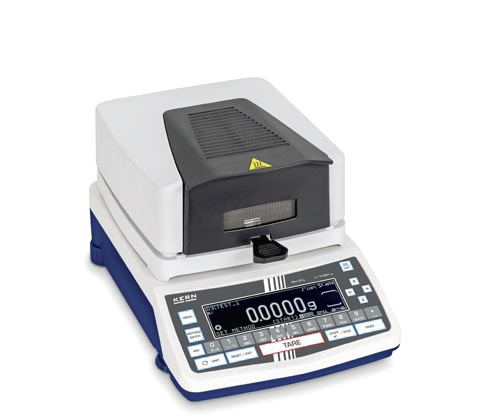
KERN DBS and DIS determine the change in sample mass during heating. DIS 50-4 has a 50 g capacity, 0.0001 g readability, a 30–175 °C temperature range, a three-step workflow and real-time drying-curve display. KERN lists food quality control, agricultural materials and analytical laboratories among its application areas.
The result is best described as loss on drying under a defined programme. It may include water and other volatile components. Temperature, sample mass, distribution on the pan and end-point criterion must be selected for the matrix and checked against the accepted reference method. This turns a rapid moisture analyser into a repeatable process-control tool rather than a source of isolated numbers.
GOST standards that can be supported with KERN equipment
A standard applies to a specific operation, product and complete measurement procedure, not to the logo on an instrument. It is therefore inaccurate to claim that one instrument “complies with every GOST”. LabLog first identifies the normative method, then checks capacity, readability or verification scale interval, accuracy class, temperature programme, sample preparation, required version, weights and result-control rules. For use in Uzbekistan, the current edition and national applicability must also be confirmed.
Non-automatic balances can be configured with GOST OIML R 76-1-2011 in mind, while prepacked-goods quantity control relates to GOST 8.579-2019. Test weights are selected under GOST OIML R 111-1-2009 and the required E1–M3 class. DBS/DIS analysers can directly support development of the infrared thermogravimetric procedure included in GOST 15113.4-2021 for food concentrates and the rapid analyser method in GOST 12570-2024 for sugar. For grain, meat, dairy and confectionery, the rapid programme is compared with the relevant reference procedures in GOST 13586.5-2015, GOST 9793-2016, GOST 3626-73 and GOST 5900-2014. Where the product standard does not permit this analyser type, DBS/DIS results are used for internal rapid control rather than as a substitute for the reference method.
ORA, ORM and ORL refractometers can be configured for GOST ISO 2173-2013 and GOST 34128-2017 procedures when range, resolution, temperature control and verification with water or reference solutions are suitable. The OBL 127 microscope can form part of a GOST 23392-2016 meat-freshness microscopy workflow when sample preparation, magnification and assessment rules are followed. None of these standards removes the need for method validation, metrological traceability and operator training.
- Balances: GOST OIML R 76-1-2011; prepacked goods: GOST 8.579-2019
- Test weights: GOST OIML R 111-1-2009
- Moisture: GOST 15113.4-2021 and GOST 12570-2024; comparison with product-specific reference standards remains essential
- Refractometry: GOST ISO 2173-2013 and GOST 34128-2017
- Meat microscopy: GOST 23392-2016
Microscopy: visual inspection without overclaiming
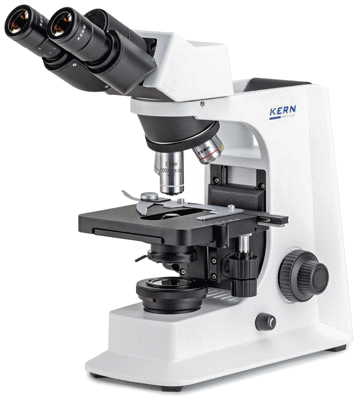
OZL-46 stereo microscopes provide a three-dimensional view and working distance for inspecting surfaces, packaging, grain, particles and foreign matter. The OBL 127 transmitted-light microscope has an infinity optical system, binocular tube, 4×, 10×, 40× and 100× objectives and LED transmitted illumination. KERN cameras can document images for the laboratory record.
A microscope alone does not confirm microbiological safety and does not replace a validated method, culture, PCR or another approved analysis. Its role is visualisation, preliminary assessment, training and documentation where these activities belong in the laboratory procedure.
How LabLog configures KERN equipment in Uzbekistan
Selection starts with an operation map: what is measured, over which range, with what permitted error, in which container and environment, how many results are generated per shift and where they are recorded. LabLog then confirms the instrument version, platform, interfaces, weights, accessories, adjustment and calibration requirements, training and service.
Prices are not published on the website because one product family may contain different capacities, readability, platform sizes, verified versions and accessory packages. Submit a request or contact us on Telegram, and LabLog will prepare a technically comparable proposal for a food plant or laboratory in Uzbekistan.
- Define matrices, ranges, containers and measurement volume
- Match models, versions, accessories and metrology
- Arrange supply, commissioning, training and support in Uzbekistan
FAQ
FAQ
Which GOST standards can KERN equipment support?+
Depending on model and version, balances can be selected around GOST OIML R 76-1-2011 and GOST 8.579-2019, weights around GOST OIML R 111-1-2009, moisture analysers around GOST 15113.4-2021 and GOST 12570-2024 or as a rapid method validated against a product standard, refractometers around GOST ISO 2173-2013 and GOST 34128-2017, and microscopes for workflows such as GOST 23392-2016. Compliance is never claimed from a model name alone.
Which KERN balances suit food production?+
Analytical or precision balances are used for laboratory samples, bench scales for formulation and portions, and platform or floor scales for containers and pallets. The exact version depends on range, readability, cleaning and metrology.
What does a KERN refractometer measure?+
A refractometer measures refractive index and reports it on a selected scale such as Brix or NaCl. The scale and correlation must be checked for the actual complex matrix.
Does a moisture analyser replace a drying oven?+
It accelerates routine control, but the heating programme and end point must be validated against the accepted reference method. Some regulated procedures still require an oven method.
Can one KERN instrument cover every task?+
Usually not. Laboratory samples, filling, heavy containers, Brix, moisture and microscopy use different measurement principles and require separate instruments or modules.
Where can KERN be ordered in Uzbekistan?+
LabLog helps select the model and version, configure accessories and weights, and arrange supply, commissioning, training and service in Uzbekistan. Pricing follows confirmation of the complete configuration.
Sources and documents
- KERN & SOHN: official manufacturer website
- KERN: 440 precision balances
- KERN: DIS 50-4 moisture analyser
- KERN: ORL 94LM food refractometer
- KERN: OBL 127 microscope
- Rosstandart: GOST OIML R 76-1-2011 — non-automatic weighing instruments
- Rosstandart: GOST 8.579-2019 — quantity of prepacked goods
- Rosstandart: GOST OIML R 111-1-2009 — test weights
- Rosstandart: GOST 15113.4-2021 — moisture in food concentrates
- Rosstandart: GOST 12570-2024 — moisture and solids in sugar
- Rosstandart: GOST 13586.5-2015 — grain moisture
- Rosstandart: GOST 9793-2016 — moisture in meat and meat products
- Rosstandart: GOST 3626-73 — moisture and solids in dairy products
- Rosstandart: GOST 5900-2014 — moisture and solids in confectionery
- Rosstandart: GOST ISO 2173-2013 — refractometry
- Rosstandart: GOST 34128-2017 — soluble solids in juice products
- Rosstandart: GOST 23392-2016 — microscopic analysis of meat freshness
Next step
LabLog will configure a KERN measurement package for your task
Send the products and matrices, minimum and maximum loads, measurements per shift, cleaning requirements and report format. We will compare KERN series, accessories and metrology and prepare a working configuration for your facility in Uzbekistan.
- Select models by range, readability and permitted error
- Check platforms, protection, interfaces, weights and documentation
- Arrange supply, commissioning, training and service support
The form request reaches the LabLog team’s Telegram chat. A specialist will contact you to clarify the inputs.