
FOSS / dairy production
Milk composition control: how to protect fat, protein and margin
In dairy production, margin is often lost quietly: a little more fat goes into the product, protein deviation is detected too late, a batch waits for the laboratory, and the technologist is no longer controlling the process but dealing with consequences. FOSS has built dairy solutions around a simple idea: composition must be seen quickly, consistently and at the right point of the process — before an error becomes expensive.

Losses start in the process, not in the report
Fat, protein, solids and moisture are not just report numbers. In milk and dairy products they define batch economics: how much raw material goes into the product, how accurately the recipe is held, what the yield will be and whether quality stays stable from shift to shift. Even a small systematic deviation becomes visible when production runs dozens or hundreds of batches. Composition control is therefore not only a laboratory topic. It is a question of money, process discipline and confidence in release.
Why fat and protein should not be given away “with a safety margin”
In practice, many plants try to be safe: slightly above target feels better than receiving a claim. But if fat or protein consistently runs above the target, the plant is effectively giving away valuable components for free. If the value runs below target, there are risks for recipe, labelling, taste, texture and customer confidence. Good composition control is not about a pretty report; it is about keeping the product in a narrow working window: not below specification and not above the economically reasonable level.
The laboratory remains the trust base
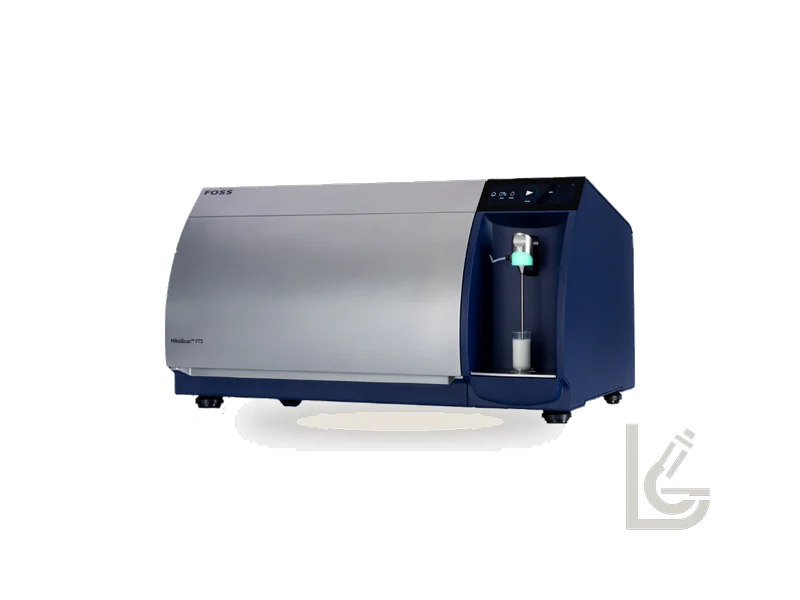
Laboratory FTIR analysis remains the base trust point. At intake it helps assess raw material fairly; in production it checks standardisation and batch stability; at final control it confirms that the product meets internal requirements. MilkoScan Mars covers compact routine FTIR control of raw milk and cream, while MilkoScan FT3 is designed for a wider range of liquid and semi-solid dairy products: milk, cream, whey, yoghurt, chocolate milk, concentrates and plant-based drinks. This matters when a laboratory works not with one matrix, but with a real product range.
What MilkoScan FT3 actually measures
According to the official FOSS specification, MilkoScan FT3 global calibrations include fat, protein, lactose, total solids, solids-not-fat, freezing point, titratable acidity, density, free fatty acids, casein, urea and other parameters. For milk, the stated measurement time is from 30 seconds, sample volume is below 8 ml, and sample temperature can be 5–55 °C when the sample is homogeneous. For a laboratory this is not just a long parameter list. It is a way to connect the result faster to a process action: accept raw material, adjust standardisation, check a batch or detect an adulteration risk.
Instrument stability matters as much as the parameter list
People often ask: “Which parameters does the instrument measure?” For a serious laboratory the question is wider: how consistently does it measure them every day. FOSS specifies automatic standardisation every two hours for MilkoScan FT3, a smart flow system, automatic zero setting and cleaning, and the ability to manage multiple instruments in a network so that results remain comparable. This is the part that is not visible in a simple parameter table, but it directly affects reproducibility and trust in the numbers.
But one laboratory point is often not enough
As production grows, final analysis stops being the only control point. Imagine this: the product is already mixed, the batch is nearly ready, and the laboratory shows a deviation. Formally, control worked, but economically it worked too late: the batch must be corrected, delayed or released with a compromise decision. That is why modern dairy production adds measurement points closer to the process: before mixing, after standardisation, before pasteurisation, before filling, at the line or near the line. FOSS directly describes the role of NIR, FTIR and automated analysis at many points in the complex dairy process, from optimising fat content to screening incoming raw milk for adulteration.
At-line and in-line control protect margin
At-line control means measurement near the production line, where an operator or technologist gets data quickly and can adjust the process. In-line control means measurement directly in the flow, with data arriving almost continuously. In its article on yield in modern dairy, FOSS specifically discusses the move from at-line to in-line analysis and the role of analytics in securing yield. The logic is clear: the earlier a deviation is visible, the cheaper it is to correct. Fast data helps avoid giving away extra fat and protein, keep recipes stable, reduce rework and make batch decisions faster.
What a good control system looks like
A strong setup is usually built not around one instrument, but around the product route. First, incoming milk is controlled: composition, possible deviations, adulteration indicators, temperature, acidity and other critical parameters. Then standardisation and mixing are controlled: whether fat runs above target, protein drops, or solids remain stable. Intermediate and final products are then checked. In this logic, the laboratory, at-line instruments, in-line analysers, LIMS and service become parts of one system, not separate purchases.
Where the effect appears fastest
First, raw material intake: milk quality and risky batches are visible faster. Second, standardisation: fat and protein can be kept closer to target. Third, products where errors are expensive: cream, yoghurt, cheese, desserts and dairy concentrates. Fourth, plants with a high sample load, where laboratory delay becomes a queue of decisions. The larger the volume and the broader the product range, the more important not only accuracy but also result speed becomes.
Why FOSS is especially strong here
FOSS is a global leader in dairy analytics, and its strength is not only the brand name. The depth of the system matters: instruments, calibrations, sample handling, standardisation, network management, service logic and understanding of the dairy process. On the MilkoScan FT3 page, FOSS directly connects the instrument with raw material testing, milk standardisation, process control and end-product control. That is why the right discussion is not “which analyser to buy”, but “how to build composition control that can be trusted every day”.
MilkoScan Mars or FT3: short and practical
MilkoScan Mars is worth considering when compact FTIR analysis of raw milk and cream is needed, with user-friendly operation, automatic standardisation, no chemicals or disposables for measurement, and adulteration screening options. MilkoScan FT3 is the next level for laboratories and plants with more products, higher sample load, liquid and semi-solid matrices, networked instruments, broader calibrations and high result stability. In both cases, selection should not be based on a “nice parameter list”, but on the task: what is measured, how many samples per day, where the decision is made and how expensive an error is.
How LabLog helps implement it in Uzbekistan
LabLog Group selects the configuration for the real task, not simply “from a catalogue”. We clarify sample flow, product range, target parameters, accuracy requirements, staff skills, consumables, service plan and the exact point where the result must influence a decision. We work only in Uzbekistan: we demonstrate equipment in Tashkent, train users, help integrate the method into daily control and support the instrument after launch. A good analyser is important, but a properly implemented quality-control system is even more important.
FAQ
FAQ
Why is milk composition directly linked to production economics?+
Fat, protein, solids and composition stability affect standardisation, recipes, yield and losses. The earlier a plant sees a deviation, the faster it can correct the process.
Which FOSS instrument should be chosen for composition control?+
MilkoScan Mars is suitable for intake and fast routine control. MilkoScan FT3 is selected when a deeper laboratory system is needed for raw material, process, finished product and data history.
Can a staged control system be built?+
Yes. A typical system covers raw milk intake, standardisation, process, finished product and data accumulation. LabLog helps select a configuration for the sample flow and real control points of the plant.
Sources and documents