
Hoof care and safe restraint
Rosensteiner cattle equipment: a current selection guide
Rosensteiner is not three similar crushes but several distinct workflows: standing or recumbent treatment, farm or professional use, stationary or mobile equipment, dedicated veterinary restraint and powered cattle entry. This guide maps the current manufacturer range, separates cycle claims from real throughput and explains how to design a safer workstation.

In short
Current manufacturer range: the right system for each task
The current official Rosensteiner catalogue is not divided merely by drive power. Top 5 and Red 5 are walk-through crushes for standing cattle. Kipp Top II and RS-Q place cattle laterally: the former supports recurring farm and mobile work, while the latter targets professional throughput with fully hydraulic restraint. Vet Pro is designed for veterinary diagnosis, treatment and surgery on standing or recumbent cattle. Bull Top addresses bulls and beef animals.
Moover is not a trimming crush but a powered waiting and advancement box for walk-through or rollover stations. Sani Top is a separate lifter for recumbent cattle used under veterinary direction. The adjacent farm range includes LiboX for deep-bedded cubicles; transport equipment includes Kendo, Aikido, Judo, Samurai and Sumo buckets. A Red Q page remains online, but the model is absent from the manufacturer’s current primary catalogue navigation, so availability and status require direct confirmation.
- Standing: Top 5, Red 5, Bull Top
- Rollover: Kipp Top II, RS-Q; veterinary Vet Pro
- Flow and care: Moover, Sani Top, LiboX
Start with the workflow, not the model
Before comparing drives, record herd size, daily cases and seasonal peaks, animal weight and type, horns, who performs trimming and whether the crush serves one or several farms. Map the route separately: waiting area, approach without sharp turns, entry, restraint, working sides, exit and washdown.
WOAH recommends that cattle handling and restraint equipment be designed and used to minimise pain, injury and distress. Reluctance to enter, slipping, falling, striking equipment, unusual vocalisation and post-procedure injuries are practical warning indicators. They should be recorded alongside animal numbers.
Top 5: a practical farm foundation
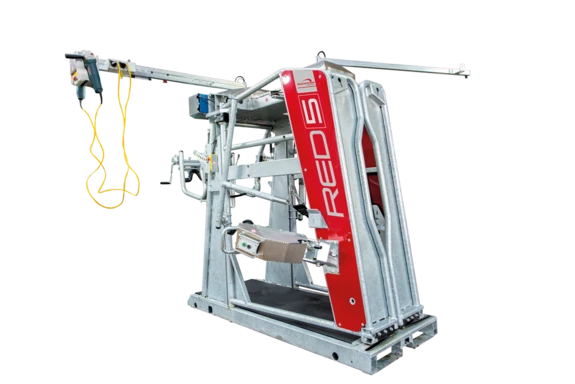
Top 5 is built around the five steps of functional trimming. Crossed belly belts help prevent turning or lying down, while front and rear limbs are lifted separately. Rosensteiner positions it from small-farm configurations through the Professional version with electric winches, lighting, sockets and tool holders.
It is a rational stationary choice for preventive work and urgent checks between professional trimmer visits. Configuration should follow work frequency as well as purchase price: manual operations may suit modest use, while repeated work increases the value of powered lifts and an organised service arm.

Red 5: walk-through layout and higher throughput
Red 5 is an electrically powered walk-through crush. Its head bail opens across the full width for horned and polled cattle. Electric front and rear lifts, a double-V hind-limb support, wide chest belt and service arm reduce manual force and operator travel. The manufacturer states about 45 seconds to catch and prepare an animal.
That figure covers one stage, not complete trimming. Actual throughput depends on cattle flow and behaviour, hoof condition, treatments, tool changes, records and cleaning. Red 5 makes sense where recurring volume justifies a walk-through layout and powered workplace; electrical supply, protection, cable routes and safe access to controls must be checked before ordering.
RS-Q: hydraulics and professional mobility
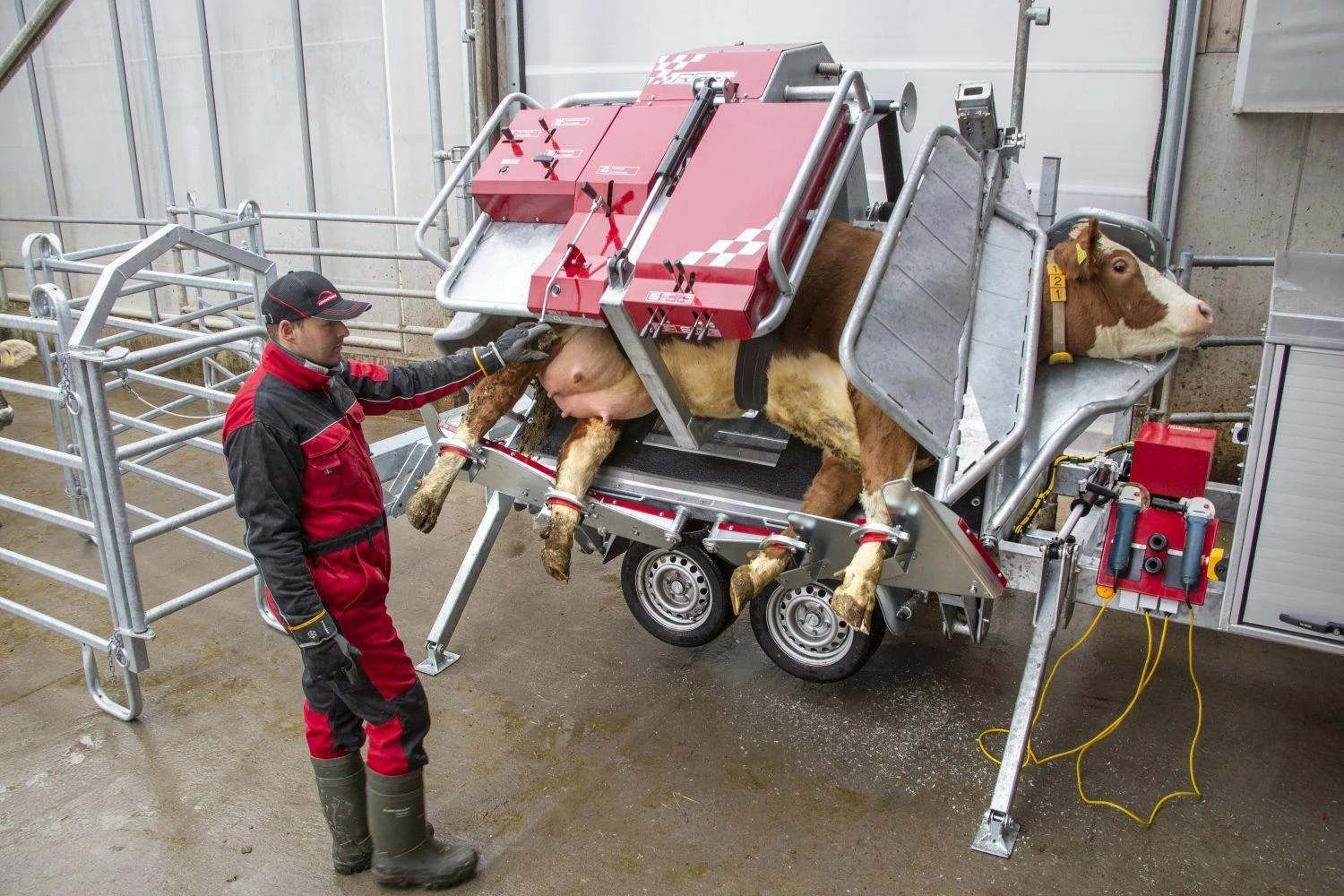
RS-Q is a rollover system with hydraulic catching, belly belt and limb restraint controlled from a central panel. Rosensteiner states approximately 30 seconds from entry to all four hooves in working position. It is offered as a stationary unit, professional trailer or individually configured truck installation.
It suits professional services and large operations able to utilise its capacity. Higher capability also raises requirements: trained operation, controlled clearance around moving parts, level foundations, power, hydraulic maintenance, safe transport and a formal pre-shift inspection. Mobility does not remove the need to prepare a safe site at every farm.
Site and flow matter more than an impressive option list
Install the crush on a strong level base with non-slip approach and clearance for every working position. Cattle should see a clear exit; shadows, glare, noise, steps and abrupt narrowing hinder flow. Allow room for operator, assistant, tools and emergency release without crossing tractor, feed vehicle or herd routes.
The project includes shadow-free lighting, protected sockets, cables and isolation, water and washdown drainage, plus separation of clean tools and contaminated waste. Catalogue dimensions describe the machine, not the complete workstation. RS-Q and mobile versions also require separate checks of transport and operating envelopes.
Safe restraint is a procedure
Before each shift, inspect barriers, floor, belts, ropes, winches, limb supports, head bail, emergency release, lighting and electrical or hydraulic systems. Operator care cannot compensate for a damaged component. Move cattle calmly, keep people outside pinch and kick zones, adjust restraint to each animal and monitor its condition continuously.
The procedure defines operator and assistant roles, commands, restraint and release sequence, stopping for falls or panic, power-loss response and prohibition of unauthorised modifications. Training covers abnormal recovery as well as the normal cycle. The model-specific manual takes precedence over general guidance.
- Pre-shift inspection
- One clear command and action sequence
- Practised emergency release
Selecting Rosensteiner in Uzbekistan
A technical brief should state animal type and weight range, herd and case volume, stationary or mobile use, building layout, power supply, transport method, staffing and current tools. Comparison then covers model and version, options, delivery, installation, commissioning, training and critical spares.
LabLog helps compare Rosensteiner crushes, veterinary restraint and farm systems, review the site and utilities, configure the package and arrange supply and commissioning. Trimming, lesion diagnosis and treatment remain tasks for trained personnel working under an approved veterinary procedure.
FAQ
FAQ
Which Rosensteiner model suits a farm?+
Top 5 suits a practical stationary post and moderate use. Red 5 supports recurring walk-through work with powered lifts. RS-Q targets professional services and high utilisation, including mobile work. Animals, workload, site and operator determine the final choice.
Do 45 or 30 seconds define crush throughput?+
No. These are manufacturer timings for specific restraint stages. A complete cycle includes cattle flow, trimming, possible treatment, tool changes, records, exit and cleaning.
Can one crush serve dairy and beef cattle?+
Some models cover both, but weight, body dimensions, horns, behaviour and restraint method must be checked. Maximum weight alone is insufficient.
What must be prepared before installation?+
Prepare a level base, non-slip approach, safe entry and exit, working clearances, lighting, the specified power supply, emergency isolation, washdown and drainage. A mobile unit requires site checks at every stop.
Does the crush replace a trained hoof trimmer?+
No. The crush provides restraint and access. Locomotion and hoof assessment, functional trimming, lesion recognition and treatment require competent personnel and a veterinary procedure.
Sources and documents
- Rosensteiner: official Top 5 overview
- Rosensteiner: official Red 5 overview
- Rosensteiner: Red 5 configurations
- Rosensteiner: official RS-Q overview
- Rosensteiner: current hoof-care equipment catalogue
- Rosensteiner: Kipp Top II
- Rosensteiner: Vet Pro
- Rosensteiner: Bull Top
- Rosensteiner: Moover
- Rosensteiner: Sani Top
- Rosensteiner: LiboX
- WOAH: dairy cattle welfare and safe restraint