
National quality-control system
AgroControl Uzbekistan: designing a national food-quality control system
A government cannot build reliable food control by purchasing analysers and collecting results in one spreadsheet. It needs a governed system: common methods, a reference centre, comparable calibrations, protected data flows, response rules and clear accountability. AgroControl Uzbekistan is a project concept for this infrastructure across milk, meat, grain, feed and other food products in Uzbekistan.

In short
Why Uzbekistan needs a unified quality-control framework
When laboratories, plants and intake points use different formats, government receives delayed reporting and poorly comparable data. A unified framework must answer practical questions: what was tested, under which method, on which instrument, who verified the result, what the calibration history shows and what decision was made for the batch.
The goal is not to replace laboratory professionals with an algorithm. It is to make measurements traceable, identify risk faster and give the competent authority a comparable view across regions, products and market participants.
Architecture: from sample to policy decision
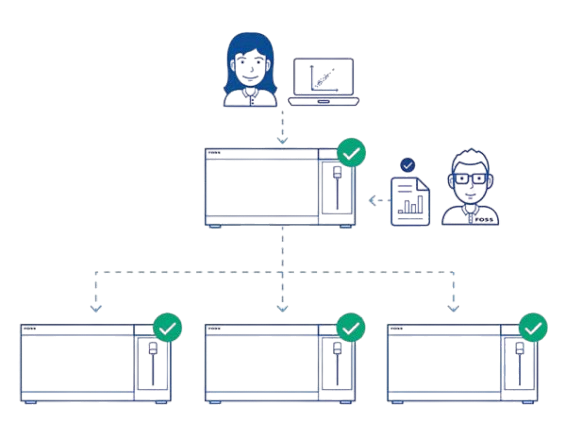
A working architecture starts not with a dashboard, but with batch identification and sampling rules. The connected analyser then produces a result, automated and laboratory checks add method context, and the record enters the central framework. Aggregated indicators, trends, alerts and investigation evidence become available at the governing level.
Government use requires predefined data ownership, access roles, retention, electronic signatures, audit logs, LIMS and public-system integration, hosting requirements and incident response. FOSS IQX can serve as a digital core for instrument and analytical-data management, while the national API and security architecture must be designed separately.

FOSS instrument layer: different tasks require different analysers
A central dairy laboratory can use MilkoScan FT3: FOSS specifies liquid and semi-solid dairy analysis, automatic standardisation and milk results from 30 seconds. Distributed intake points can use MilkoScan Mars for up to six key parameters in about one minute. FoodScan 2 measures meat composition and colour from incoming material to final control. Infratec and NIRS DS3 cover grain and feed, while Kjeltec and Soxtec support reference protein and fat methods.
No instrument is automatically suitable for an official decision. Every matrix needs a defined calibration, range, accuracy, sample preparation, control materials, applicable standard and procedure for confirming disputed results.
- Milk: GOST 32255-2013 and ISO 9622 within a verified procedure and calibration
- Grain and feed: GOST ISO 12099-2017; FOSS states AOAC 2007.04 for FoodScan 2 Meat
- Protein and nitrogen: matrix-specific GOST 23327-98, 25011-2017, 10846-91 and 13496.4-2019
Rapid methods do not replace the reference laboratory
FTIR and NIR can estimate several parameters rapidly without reagents, but the reference system creates trust in the network. A central laboratory develops and verifies calibrations, uses control materials, runs proficiency comparisons and resolves disputed samples under approved methods.
The sound model therefore combines high-volume instrumental screening with reference confirmation. Market access, enforcement or recall decisions should not be fully automated from one rapid result without an approved procedure and a right to confirmatory analysis.
What the public authority should see
A ministry needs a governance model rather than a screen of attractive numbers. The core view includes batch and regional coverage, out-of-limit rates, trends by product and supplier, device status, control samples, overdue checks, correction history and alert response time. Every indicator must drill down to the original measurement and audit trail.
An alert threshold is not a legal decision. It initiates an approved workflow: repeat testing, confirmation, laboratory review, notification and a documented decision.
Pilot first, not a risky nationwide launch
A rational first stage uses one product chain, one reference centre and a limited number of sites—for example raw milk intake and a central laboratory, or grain in one region. Baselines and targets are fixed before launch: coverage, uncertainty, time to result, data completeness, device availability and discrepancy handling.
The pilot ends with independent acceptance of matrix performance, cyber security, connectivity resilience, audit trails, training and total cost of ownership. Only then should a national specification, budget and expansion schedule be approved.
- Stage 1: regulatory and laboratory audit
- Stage 2: pilot on real batches and matrices
- Stage 3: independent assessment and requirements update
- Stage 4: regional and sector expansion
The roles of LabLog and FOSS
FOSS provides analytical technology, calibrations, digital device-management tools and international application expertise. LabLog acts as a local adviser and integrator in Uzbekistan: translating policy needs into a technical brief, auditing laboratories, configuring solutions and coordinating supply, commissioning, training, service and local stakeholders.
The authorised Uzbek public body remains the owner of policy, regulation and government data. The final model must be designed jointly with ministries, metrology, laboratories, IT and information-security teams.
Conclusion: government needs a trusted measurement system
AgroControl Uzbekistan should be treated not as an equipment purchase or an off-the-shelf software product, but as a national quality-control transformation programme. Value appears only when instruments, methods, calibrations, data, people and legal procedures operate as one system.
LabLog can prepare a pre-project assessment and pilot architecture covering the product chain, control points, laboratories, FOSS instrument fleet, reference methods, digital framework, acceptance criteria, training and service. The correct next step is a working session with process owners and agreement on a pilot—not a promise of instant nationwide deployment.
FAQ
FAQ
Is AgroControl Uzbekistan already an operating government system?+
No. It is a LabLog project concept for discussion with competent authorities and industry. Scope, architecture, regulation and equipment are defined after assessment and a pilot.
Can a legally significant decision rely only on rapid FTIR/NIR analysis?+
Only where an approved and metrologically supported procedure explicitly allows it. Otherwise rapid analysis is screening and disputed or critical results require reference confirmation.
How should a national project start?+
Start with regulatory and laboratory assessment, select one product chain, define data and roles, then run a limited pilot with measurable success criteria and independent acceptance.
What does FOSS IQX do?+
FOSS states that IQX centralises measurement-device and data management and supports monitoring, reporting, supplier quality and analytical models. Government integration is designed separately.
Sources and documents
- FOSS digital services and IQX platform
- FOSS MilkoScan FT3 — official capabilities and specification
- FOSS FoodScan 2 Meat — official overview
- FOSS company and history since 1956
- Rosstandart: GOST 32255-2013 for infrared milk analysis
- Rosstandart: GOST ISO 12099-2017 for grain and feed NIR
- Rosstandart: GOST 25011-2017 — protein in meat
- Rosstandart: GOST 13496.4-2019 — nitrogen and crude protein in feed
From concept to pilot
LabLog will prepare an AgroControl Uzbekistan pre-project assessment
A national or sector programme should begin by defining the product chain, regulatory model, data ownership and acceptance criteria. LabLog can translate the task into a verifiable pilot architecture using FOSS technology—without premature nationwide promises.
- Define products, control points, roles and confirmation workflows
- Map laboratories, FOSS analysers, reference methods and applicable standards
- Specify the digital framework, data security, pilot criteria, training and service
The request reaches the LabLog team’s Telegram chat. We will contact you to arrange a working session and clarify the project scope.