
Food safety
Hygiena BAX Q7 PCR: controlling foodborne pathogens
How to test for Salmonella, Listeria and other foodborne pathogens, select BAX and foodproof assays, interpret results and implement PCR control. A detailed Q7, ISO, GOST and regulatory guide for businesses in Uzbekistan.

In brief: what Q7 provides
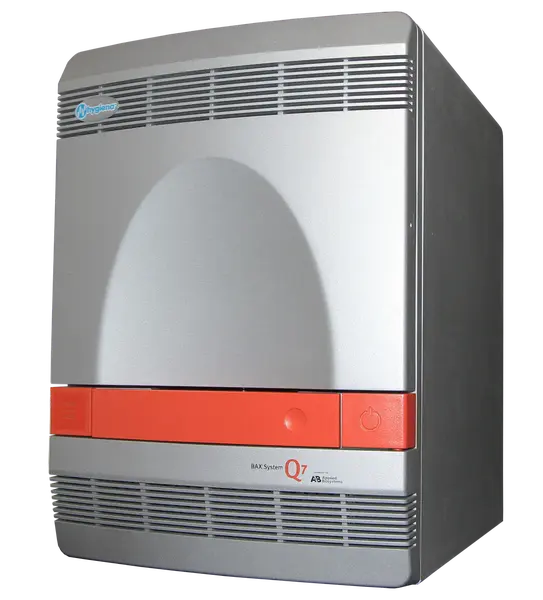
Q7 uses a 96-well format and supports compatible BAX System and foodproof assays. Hygiena offers solutions targeting Salmonella, Listeria, E. coli O157:H7 and additional organisms. Software interpretation helps standardise assessment; compatible configurations can connect to SureTrend. Assay, matrix, software version and interpretation mode must be checked separately. Purchasing the instrument does not itself demonstrate product compliance or replace the complete quality-control programme.
Why pathogens require targeted testing
Cheese can taste right, meat can have its normal colour, and a ready-meal package can be intact. These observations matter, but they do not answer whether a specific pathogen is present. Targeted microbiological testing addresses that question. Its value depends on timely, correctly interpreted results linked to a decision: accept raw material, hold a batch, investigate a deviation or release product under an approved procedure. BAX System Q7 is a laboratory PCR platform for foodborne pathogens and other assay-defined organisms. This guide explains its role for businesses and laboratories in Uzbekistan.
Fat, protein, moisture, acidity and sensory properties do not replace testing for Salmonella or L. monocytogenes. Microbiological indicators are not interchangeable either: a satisfactory total count does not prove the absence of every pathogen.
A useful programme separates supplier and incoming-material assessment, process control, hygiene monitoring and product-release testing. A rapid method is particularly valuable for short shelf-life products, occupied cold storage and time-sensitive dispatch. The objective is a faster justified decision while retaining the necessary analytical stages.
PCR can support incoming-material checks against a specification, process investigations, targeted environmental monitoring, release decisions and complaint investigations. Each application needs an appropriate sampling plan and decision procedure. Testing does not remove contamination; technology, hygiene, supplier management and competent staff remain the preventive controls.
Who should consider this approach
The following map supports method selection; it is not a mandatory universal testing schedule. Product, technology, consumers, destination market and applicable requirements determine the programme. A listed application does not mean that every assay is validated for every matrix.
| Business or laboratory | Potential investigation | What must be established |
|---|---|---|
| Dairy and cheese production | Salmonella, L. monocytogenes; Listeria spp. in suitable monitoring programmes | Raw or processed product, cheese or powder, process stage and matrix |
| Meat processing | Salmonella, E. coli O157:H7, relevant STEC; Listeria where appropriate | Raw versus ready-to-eat product, animal species and purpose |
| Poultry processing | Salmonella and Campylobacter within the selected method | Sample type, qualitative or quantitative objective |
| Ready meals and chilled foods | L. monocytogenes, Salmonella and other risk-based targets | Ready-to-eat status, growth potential and shelf life |
| Produce, greens and frozen foods | Salmonella, STEC or Listeria as appropriate | Consumer preparation, production conditions and sampling |
| Chocolate, cocoa and dry ingredients | Salmonella where required by the programme | Validated coverage of dry, fatty or inhibitory matrices |
| Infant food | Salmonella, Cronobacter and category-specific indicators | Consumer age, dry or prepared product and precise requirements |
| Fish and seafood | Listeria, Salmonella or specified Vibrio | Raw or ready-to-eat status and validated scope |
| Feed and feed ingredients | Salmonella and other required indicators | Separate confirmation of feed-matrix coverage |
| Independent testing laboratory | Multiple sectors and customer specifications | Accreditation scope, verification and acceptance of the report |
An in-house PCR laboratory is not automatically the best choice for a small business. Compare outsourcing, internal testing and a mixed model, including sample transport, response time, workload, staff competence and backup arrangements.
What PCR detects
PCR detects specified genetic targets. An assay may address a genus, species, group or genetic characteristic. Listeria spp. is not the same result as L. monocytogenes; indicator E. coli testing is not equivalent to E. coli O157:H7 or STEC testing. Detecting a marker does not automatically remove the confirmation steps required by the selected method.
ISO 22174:2024 provides general requirements for food-chain PCR. It replaces ISO 22174:2005, ISO 20837:2006, ISO 20838:2006 and ISO 22119:2011 internationally. Withdrawal of those ISO editions does not automatically cancel national GOST adoptions.
DNA detection and viability are different questions. Interpret the signal within the complete validated procedure, including sample preparation and any enrichment. If distinguishing viable cells from residual DNA is necessary, use a specifically supported approach; adding a reagent or altering preparation does not automatically preserve the original certification.
Sampling is equally important. Contamination may be unevenly distributed. A negative result means the target was not detected in the tested material under the method's conditions, not that every package in the batch was examined.
Q7 as a working laboratory system
BAX combines an instrument, assays, software, preparation and interpretation rules. Ready-made dry PCR reagents, internal controls and standardised procedures reduce some manual work but do not replace operator competence.
Ninety-six wells describe capacity, not a guaranteed number of reportable samples: controls, repeats and multiple assays per sample affect throughput. Different assays can share a run only when their instructions permit it. Current Hygiena packages include automated or manual thermal-block configurations. Confirm electrical requirements, computer, software and the complete supplied equipment. A start-up package is not an entire ready-to-operate laboratory.
Q7 is the focus of this guide. X5 remains in historical materials and assay documentation, but current new-instrument availability was not confirmed from public sources. For an installed X5, confirm consumables, service and continued support separately; this guide does not offer it as a new-purchase alternative.
BAX and foodproof: compatibility and interpretation
Using compatible reagent families on one platform expands its applications, but does not mean every foodproof assay receives fully automatic interpretation. Hygiena software 5.2.0.36505 distinguishes the following modes.
| Mode | Software output | Specialist's role |
|---|---|---|
| Certified | Validated automated interpretation | Check the run and the applicability of the result within laboratory procedures |
| Experimental | Software-assisted classification | Visual graph review and user interpretation are required |
| None | Raw amplification data | User interpretation is required |
Some foodproof applications require additional calibration. Confirm assay compatibility, algorithm status and kit instructions together. A proposal should connect the analytical question, matrix, kit, instruction revision, software, interpretation and supporting documents.
Assay directions and SalQuant
The supplied BAX materials describe Salmonella, Listeria spp., L. monocytogenes, E. coli O157:H7, STEC, Cronobacter, Campylobacter, Shigella, Staphylococcus aureus, Vibrio and selected yeast/mould investigations. This is a portfolio map, not a single universal kit. Confirm current product codes, availability and scope for each application.
Distinguish STEC marker screening from subsequent identification, and yeast/mould detection from quantification. Validation for raw meat cannot be assumed to cover chocolate. Sensitivity demonstrated for one test portion and matrix is not a universal claim for every sample size or food.
BAX System SalQuant provides a dedicated approach to Salmonella quantification in supported matrices. Hygiena describes poultry, beef and pork applications with different protocols and validation scopes. Quantification can support process comparisons and intervention assessment. An ordinary qualitative positive after enrichment cannot simply be converted from Ct to the original CFU/g. A specifically validated quantitative procedure is required.
Total time to a decision
Compare methods by the full turnaround time: transport and registration, preparation and any required enrichment, PCR, review of controls, required confirmation and reporting. Each stage depends on the method and matrix.
Instrument-cycle durations in a brochure must not become promises of a complete result for every food within an hour. A next-day claim also needs a defined matrix, procedure and starting point. Agree both the expected initial result time and the possible final-report time when confirmation is necessary. This helps production plan storage and dispatch realistically.
From sample to decision
This is an organisational outline, not an analytical instruction. Operating parameters come from the current approved method.
- Define the target, product, market and decision.
- Select a method with the appropriate scope and customer acceptance.
- Sample and register the material with traceability to the batch or monitoring point.
- Perform the prescribed preparation, controls and analysis.
- Assess run validity, errors and deviations.
- Review and report the result with its method and relevant limitations.
- Apply the site's release, hold or investigation procedure.
The person responsible for release must understand which question the result answers and what further evidence is needed. Laboratory testing must be connected to quality management.
Interpreting results
| Result | Meaning | Next action |
|---|---|---|
| Negative with acceptable controls | Target not detected in the tested material within the method | Assess with sampling, other results and release criteria |
| Positive or presumptive positive | A signal requiring the method's specified response | Apply hold/investigation procedures and required confirmation |
| Invalid or control/technical failure | Ordinary interpretation is not justified | Investigate and follow the instructions and quality system |
| Disagreement with another method | Samples, methods and conditions require comparison | Document and investigate the discrepancy |
An invalid result must not be reported as negative. Repeating until a convenient negative appears is not a substitute for investigation. Internal controls assess the reaction within their intended scope; they do not establish that sampling was representative, batch identity was correct or every preceding stage complied. Other required controls and quality procedures remain necessary.
The regulatory framework
Keep six levels separate: mandatory product criteria, process and hygiene requirements, analytical standards, validation of the commercial method, laboratory verification/competence, and additional customer or certification conditions. Method certification is not certification of each batch; accreditation does not automatically extend to any newly purchased assay.
Uzbekistan's Law No. 483-I of 30 August 1997, On Food Quality and Safety, provides a legal basis for product requirements and circulation. It does not mandate a particular instrument brand. General sanitary requirements SanQvaN 0079-24, approved by Resolution No. 22 of 14 November 2024, entered into force on 17 June 2025. They are not a universal BAX procedure or a single PCR test schedule for every factory. Category-specific rules also matter: SanQvaN 0059-23 covers infant-food production, safety, storage and transport.
SanQvaN 0107-26 on microbiological indicators was approved by Resolution No. 32 of 19 January 2026. LexUZ states that it has not yet entered into force: the effective date is 5 February 2028. In October 2026 it is a future planning reference, not an already applicable obligation. Build the current product-specific requirements register from rules actually in force.
For EAEU exports, check TR CU 021/2011, applicable sector regulations and current accepted-method lists. A kit's international certificate does not itself complete product conformity assessment.
For the EU, Regulation (EC) 2073/2005 establishes microbiological criteria. Amendment (EU) 2024/2895 applies from 1 July 2026. For the specified ready-to-eat foods supporting L. monocytogenes growth, where the producer cannot demonstrate compliance with 100 CFU/g throughout shelf life, the absence-in-25-g criterion applies while those foods are on the market during shelf life. This is not a universal criterion for all foods. Detection, enumeration and shelf-life substantiation are different tasks.
ISO and GOST: a working reference map
These references support method implementation. They are not all automatically mandatory for every laboratory. Verify national adoption, contractual requirements, current amendments and the complete applicable text.
| Document | Purpose |
|---|---|
| ISO 22174:2024 | General requirements for food-chain PCR detection and quantification |
| ISO 16140-2:2016, Amd 1:2024 | Validation of alternative methods against a reference method |
| ISO 16140-3:2021 | Verification of validated methods in an individual laboratory; consider applicable amendments |
| ISO 16140-6:2019 | Validation of alternative microbiological confirmation and typing methods |
| ISO/IEC 17025:2017 | Competence of testing and calibration laboratories |
| ISO 7218:2024 | General requirements and guidance for food-chain microbiological examinations |
| ISO 6887-1:2017, Amd 1:2024 | General sample-preparation and dilution rules within its scope |
| ISO 18593:2018 | Surface sampling; does not prescribe a universal monitoring programme |
| ISO 6579-1:2017, Amd 1:2020 | Reference horizontal Salmonella detection method |
| ISO 11290-1:2017 | Reference horizontal detection of L. monocytogenes and Listeria spp. |
| GOST | Relevance | Qualification |
|---|---|---|
| GOST 31659-2024 (ISO 6579-1:2017) | Salmonella detection | Replaced the 2012 edition in Russia from 1 October 2025; Uzbekistan applicability requires separate verification |
| GOST 32031-2022 | L. monocytogenes and Listeria spp. detection | Replaced the 2012 edition in Russia; verify national adoption and contracts |
| GOST R 52833-2007 (ISO 22174:2005) | General PCR requirements for pathogen detection | Russian national standard; not automatically mandatory in Uzbekistan; its ISO basis has since been updated |
A GOST number for Salmonella does not automatically make every commercial PCR an examination performed under that GOST. State the actual method and its accepted basis accurately. Official catalogue checks establish titles, editions and status, not a clause-by-clause review of paid standards.
What AOAC and AFNOR validation demonstrates
Check the specific assay, product code, matrices, test portion, procedure revision, restrictions and validity period. For example, NF VALIDATION certificate QUA 18/08-03/15 concerns BAX System Real-Time PCR Assay Salmonella spp. KIT2006. The reviewed certificate references EN ISO 16140-2 validation and EN ISO 6579-1, with validity to 26 March 2027 and specified software conditions. It does not certify every Q7 assay.
A laboratory must still complete the required implementation and verification. Regulatory or export use also depends on acceptance for the intended purpose. Validation asks whether method characteristics are established within the stated scope; verification asks whether the laboratory can achieve the required performance in its own conditions.
Connecting PCR, HACCP and environmental monitoring
HACCP begins with hazard analysis and process control. Testing can help verify measures but cannot replace them. Codex CXC 1-1969, General Principles of Food Hygiene, revised in 2022, provides an international foundation.
Environmental monitoring must connect each location to a question and a response. Cleaning verification, indicator-organism monitoring and pathogen detection serve different purposes. A location near exposed ready-to-eat food requires different interpretation from a remote technical area. ISO 18593 covers surface sampling methods but does not assign universal frequencies or point counts.
Trends help investigate recurring deviations by location, shift, raw material or operation. The objective is to address causes and verify corrective actions, not merely collect individual test results.
Where other Hygiena solutions fit
| Task | Solutions to consider | Important distinction |
|---|---|---|
| Rapid cleaning verification | EnSURE Touch or SystemSURE Plus with compatible ATP tests; UltraSnap, SuperSnap, AquaSnap according to intended use | RLU is an ATP signal, not the count of a specified pathogen |
| Indicator-organism monitoring | MicroSnap Total, Enterobacteriaceae, Coliform and E. coli with the specified reader | Indicator results do not replace all pathogen tests |
| Targeted environmental screening | Appropriate InSite tests | Assess and confirm positives according to the method |
| Molecular investigations | Q7 with compatible BAX/foodproof assays | Select by target, matrix and required evidence |
| Commercial-sterility screening | Innovate for suitable products | A different principle; reading time excludes the complete preparation/incubation period |
| Specific allergens | AlerTox, GlutenTox and relevant specialist assays | Targeted allergen tests are not replaced by ATP |
| Protein residues | AllerSnap | General protein is not proof of absence of every specific allergen |
| Records and trends | SureTrend in an agreed configuration | Data management supports, but does not replace, authorised decisions |
Instrument and consumable compatibility must be checked individually. A DNA test for an ingredient source is not equivalent to testing its allergenic protein. The analytical question, processing and intended use determine the method.
Preparing implementation
Start with products, test volumes, target organisms, markets, existing methods and required decision times. Assess premises, separation of activities, contamination prevention, biosafety, waste, competence and quality management. Closed PCR tubes do not remove those responsibilities.
Besides the cycler and computer, the laboratory needs suitable preparation, dispensing, storage, condition monitoring and record systems. Final configuration depends on the methods and existing equipment; an archived package list is not a final current quotation.
Agree the analytical scope, obtain current method documents, assess readiness, specify equipment and consumables, install and train, verify methods, approve response procedures, then begin controlled routine work. Acceptance criteria come from the relevant documents and laboratory quality system.
Records to retain
Maintain traceability from product to decision: sample/batch/location identity; sampling, receipt and storage records; purpose, method and instruction revision; kit code, reagent lot and expiry; equipment identity, software and checks; controls and raw data; deviations, repeats and confirmations; reviewed report and associated product decision.
Not every field belongs on the external report, but the full record must be retrievable. For cloud systems, agree access roles, export, backup and retention arrangements.
Evaluating the business case
Cost per test includes consumables, controls, staff time, equipment, service, training, waste, repeats and confirmation. Potential benefits include shorter justified product holds, better storage planning and earlier investigations. Validate these benefits against the site's actual operation.
Compare monthly sample volumes, urgent work, outsourced turnaround, storage cost and staff capacity across internal, external and mixed models. Do not promise a universal payback period without allowing for utilisation, reagent expiry and confirmation costs.
LabLog support in Uzbekistan
LabLog Group helps businesses and laboratories in Uzbekistan select equipment, agree configurations and organise supply, commissioning, training and service. Procedures requiring an accredited organisation must be agreed with an appropriate provider.
Selection starts with the products and decisions required. Send the product list, target indicators and sample volume so that method applicability and an appropriate configuration can be assessed. Sources, editions and statuses were checked on 12 October 2026. Practical use requires the current kit instructions and requirements for the specific product.
FAQ
FAQ
Can enrichment be omitted?+
Only where the selected method permits it for the intended application. Removing a required stage changes the method.
Does Q7 test for every pathogen at once?+
No. It runs selected assays; multiplexing and shared-run compatibility are assay-specific.
Does a negative result permit immediate dispatch?+
It supports a decision within the complete control programme, sampling plan and applicable release criteria.
Must positive PCR results be confirmed?+
Follow the selected method, its validated scope and recipient requirements. There is no universal exemption.
Can BAX replace ATP monitoring?+
They address different questions and can complement each other.
Can every Q7 result be expressed as CFU/g?+
No. Quantification requires a specifically intended and validated approach, such as a supported SalQuant application.
Does AFNOR certification authorise every use in Uzbekistan?+
No. National requirements, matrix coverage and acceptance must be assessed separately.
Are all foodproof results automatically interpreted?+
No. Experimental analysis modes require visual review and user interpretation.
Is staff training necessary?+
Yes. Automation does not replace competence in sampling, preparation, quality control and interpretation.
Is this a clinical diagnostic system?+
This guide concerns food and related production investigations; these applications must not be transferred to human clinical diagnosis.
Must a business buy its own instrument?+
No. Compare the workload, time requirements, skills and economics with outsourcing.
What information should be sent for selection?+
Products, targets, sample volume, destination markets, current methods and required response time; include the control programme or customer specification where available.
Sources and documents
- Hygiena — BAX System Q7
- ISO 22174:2024
- Hygiena — BAX System Q7 workstation
- Hygiena — instruments
- Hygiena — Q7 software 5.2.0.36505
- Hygiena — BAX System SalQuant
- LexUZ — 483-I (1997)
- LexUZ — SanQvaN 0079-24
- LexUZ — SanQvaN 0079-24 (UZ)
- LexUZ — SanQvaN 0059-23
- LexUZ — SanQvaN 0107-26 (2028)
- EEC — TR TS 021/2011
- EUR-Lex — Regulation (EU) 2024/2895
- ISO 16140-2:2016, Amd 1:2024
- ISO 16140-3:2021
- ISO 16140-6:2019
- ISO/IEC 17025:2017
- ISO 7218:2024
- ISO 6887-1:2017, Amd 1:2024
- ISO 18593:2018
- ISO 6579-1:2017
- ISO 11290-1:2017
- GOST 31659-2024 (ISO 6579-1:2017)
- GOST 32031-2022
- GOST R 52833-2007 (ISO 22174:2005)
- AFNOR — QUA 18/08-03/15
- FAO/WHO — Codex General Principles of Food Hygiene