
Food safety
Hygiena: connecting ATP monitoring, MicroSnap, PCR and allergen testing
No single test can cover every food-safety risk. ATP supports rapid cleaning verification, indicator organisms show process condition, targeted assays address a specific hazard, and data plus corrective actions turn individual results into a working programme. A Hygiena solution should therefore be selected by the question, matrix, required decision time and action after the result—not by instrument name alone. This guide maps the portfolio without mixing methods or promising more than a test can deliver.

In short
Quick selection
Hygiena method-selection map
Start with the decision the facility must make. Then select the method and verify the current instructions for the exact assay and matrix.
Verify surface or water cleaning
- Solution
- EnSURE Touch or SystemSURE Plus + a compatible ATP test
- Result type
- Rapid RLU reading
Assess indicator organisms
- Solution
- MicroSnap
- Result type
- Enumeration or presence/absence for the selected assay
Targeted environmental screening
- Solution
- InSite
- Result type
- Presumptive result after incubation
Detect a target pathogen or organism
- Solution
- BAX System / foodproof real-time PCR
- Result type
- Specific molecular result within a validated workflow
Screen product commercial sterility
- Solution
- Innovate
- Result type
- High-throughput microbial screening after product preparation
Check allergen residues
- Solution
- AlerTox / GlutenTox / ELISA / foodproof PCR
- Result type
- Qualitative, quantitative or molecular result by application
Methods complement one another. Low ATP does not prove the absence of Listeria, and a negative PCR result does not verify cleaning quality.
1. Start with the risk and decision—not the instrument
The same plant may need to monitor organic residues after cleaning, total viable organisms, environmental Listeria, Salmonella in raw materials, allergens after a changeover and spoilage in finished product. These questions require different samples, procedures and interpretation rules. Before choosing a solution, define the hazard, sampling point, matrix, decision time, sample volume and action after failure. Then verify that the exact product and current instructions support the chosen matrix and decision.
2. ATP: rapid sanitation verification
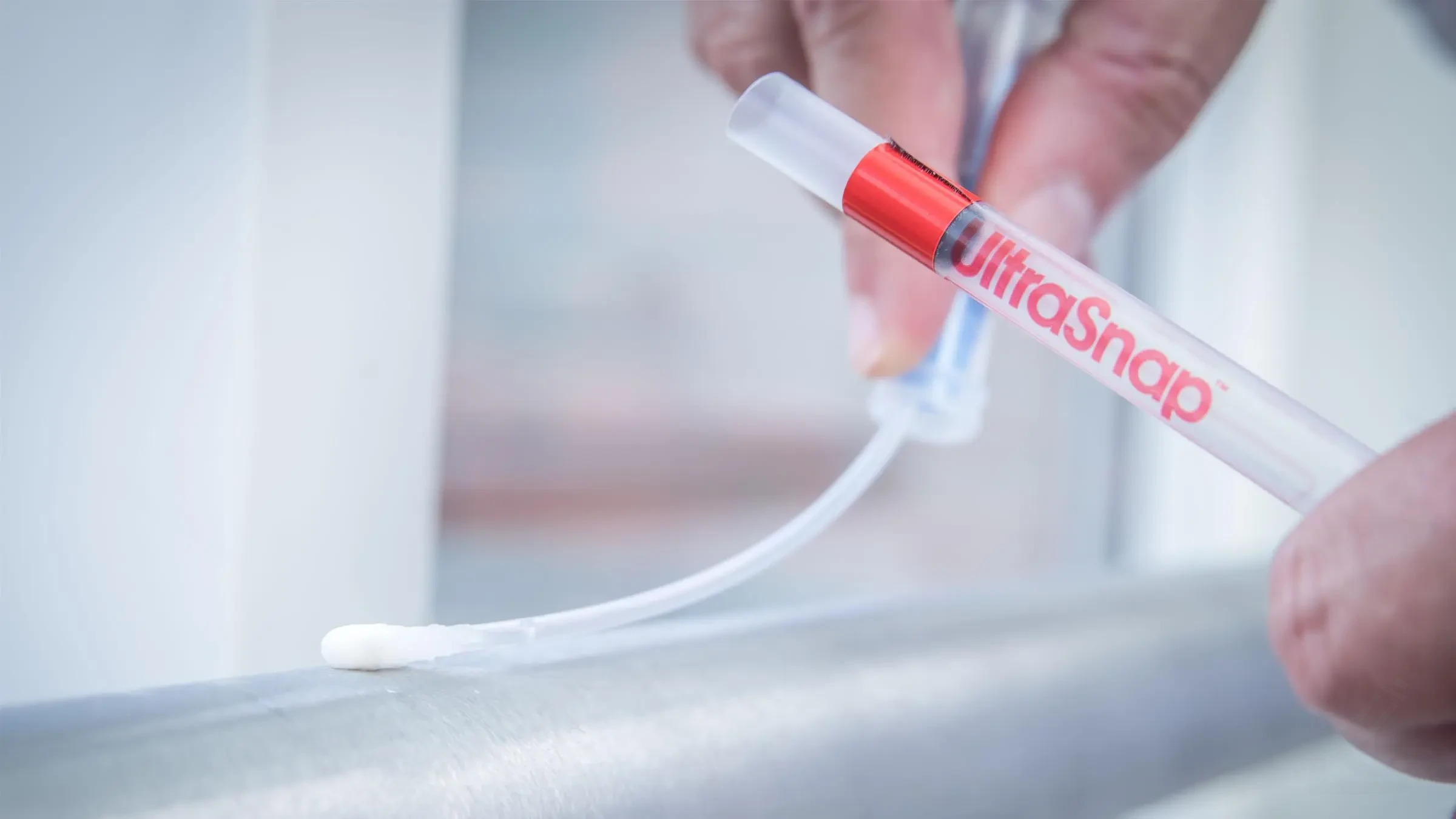
EnSURE Touch and SystemSURE Plus measure the light response from a compatible test. EnSURE Touch reports an ATP result in 10 seconds and supports Wi-Fi synchronisation; SystemSURE Plus is a simpler stand-alone instrument with a 15-second result. UltraSnap is used on surfaces, AquaSnap for water and SuperSnap when greater sensitivity is required. RLU are not CFU and do not identify an organism; limits must not be copied from another site, instrument or sampling technique without verification.
3. MicroSnap and InSite: indicator and targeted monitoring
MicroSnap is a family of bioluminogenic tests for total viable count, Enterobacteriaceae, coliforms and E. coli. Depending on the exact assay, it provides same-shift enumeration or presence/absence results; incubation remains part of the method. InSite is a self-contained format for targeted environmental screening. For example, InSite Listeria provides a presumptive colour result after incubation. The result applies only to the stated target and scope and is confirmed when required by the facility procedure.
4. BAX System and foodproof: PCR as a complete laboratory workflow
BAX System and foodproof use real-time PCR to detect specific genetic targets. Total time to result is not amplification time alone: many food applications require representative sampling, enrichment, preparation or lysis, controls and interpretation. BAX System Q7 is a 96-well platform supporting compatible BAX and foodproof assays. Organisms, matrices, certifications and confirmation rules must be checked for the selected assay; evidence for one test must not be applied to the entire portfolio.
5. Innovate: commercial sterility is not an ATP swab
Innovate supports high-throughput microbial screening of prepared finished-product samples, including dairy and beverages. It uses ATP bioluminescence but addresses a different question from UltraSnap: it does not check a surface immediately after cleaning, but screens microbial activity in a product after the required preparation and incubation. A commercial-sterility protocol must be validated for the specific product, package, incubation conditions and release criterion.
6. Allergens: general protein and specific assays are not interchangeable
A general protein test helps determine whether protein residue remains after cleaning, but it does not identify a specific allergen. AlerTox and GlutenTox use targeted lateral flow, ELISA provides a quantitative result for the stated protein, and foodproof PCR detects specific DNA. Selection depends on the allergen, product, surface, processing and decision required. Complex matrices can affect extraction and signal, so a negative result is meaningful only within the verified scope.
7. SureTrend: from isolated readings to a closed loop
SureTrend brings results, locations, plans and trends into one managed system. Value appears when a deviation is linked to a line, shift and corrective action, followed by an effectiveness check. Maps and trends can reveal recurring weak points before the average result exceeds a limit. Access roles, retention, integration and instrument connectivity should be agreed with site IT and quality teams before implementation.
8. How LabLog implements the system in Uzbekistan
A project starts with a risk and control-point map, not a universal equipment package. LabLog helps define the method, exact configuration, infrastructure, consumables and stock, then coordinates supply, commissioning, training and local support. Before routine use, the site team verifies the method on its own matrices and approves sampling, working limits, controls and deviation actions. Configuration, availability and local regulatory requirements are confirmed before ordering.
- hazard, matrix, sampling point and required decision
- sample throughput, decision time and automation level
- instruments, compatible assays, controls and consumables
- training, method verification, records and service
FAQ
FAQ
Does low ATP prove that pathogens are absent?+
No. ATP is a rapid indicator of residual biological load and cleaning effectiveness. A specific pathogen requires an appropriate targeted method and sampling plan.
How does MicroSnap differ from a standard ATP swab?+
An ATP swab rapidly checks residual biological load after cleaning. MicroSnap includes incubation and a bioluminogenic reaction for a stated group of viable organisms, so it answers a different question.
Why does PCR not always deliver a result in one hour?+
Amplification is only one stage. Food microbiology often requires sampling, transport, enrichment, lysis or extraction, controls and confirmation actions.
Can one assay check every allergen?+
No. The target, matrix and method must be defined. A general protein test does not identify an allergen, while targeted lateral-flow, ELISA and PCR methods each have a defined scope.
What does LabLog need to configure a Hygiena solution?+
Describe the product and hazard, sampling points and sample types, current method, sample volume, required decision time and deviation action. This allows the configuration and implementation plan to be selected.
Sources and documents