
Milk reception
Milk reception: what to test before unloading a tanker
A tanker has arrived at the dairy. Before connecting it to the shared tank, check raw-milk safety and composition, acidity, somatic cells and signs of adulteration. This guide connects each decision with a method and suitable equipment.


In short
Identify the batch and take samples
Check supplier documents, batch and tanker-compartment identifiers, seals, temperature, appearance and smell. Sediment, flakes or an unusual odour require investigation before normal reception continues.
This workflow concerns raw cow’s milk for industrial processing. The facility sets acceptance limits and testing frequency under applicable Uzbekistan requirements and its purchasing specification. GOST references are methodological guidance, not an automatic statement of local legal applicability.
Use a representative sample: follow the adopted mixing, sampling and preparation method. GOST 13928-84 covers milk and cream procured as raw materials. Heating or preservatives suitable for one test may interfere with another. Record sample ID, supplier, compartment, sampling time, temperature and operator. Keep a retained sample under the facility procedure and do not mix the batch with accepted milk until release.
Antibiotic screening with Bioeasy
Choose a panel for the veterinary medicines used by suppliers and the required detection thresholds. GOST 32219-2013 covers immunological methods and GOST 32254-2013 an instrumental rapid method. Compatibility with a specific standard must be documented for the kit and matrix. GOST 23454-2016 addresses inhibitory substances; it is not a universal certification for rapid strips.
For a positive, doubtful or invalid result, hold the batch separately and follow the laboratory procedure. A negative result applies only to the substances and thresholds in the selected panel. MilkoScan and somatic cell counters do not replace antibiotic testing.
- Bioeasy 4in1 BSCT: beta-lactams, streptomycin, chloramphenicol and tetracyclines.
- Bioeasy 16in1: a broader screening panel; confirm exact analytes and thresholds for the current product code.
- Bioeasy incubator: the required test conditions. A compatible Bioeasy Reader provides instrumental reading and records where supported.
Composition with FOSS, SomaticScan Combo or MilkoTester Lite
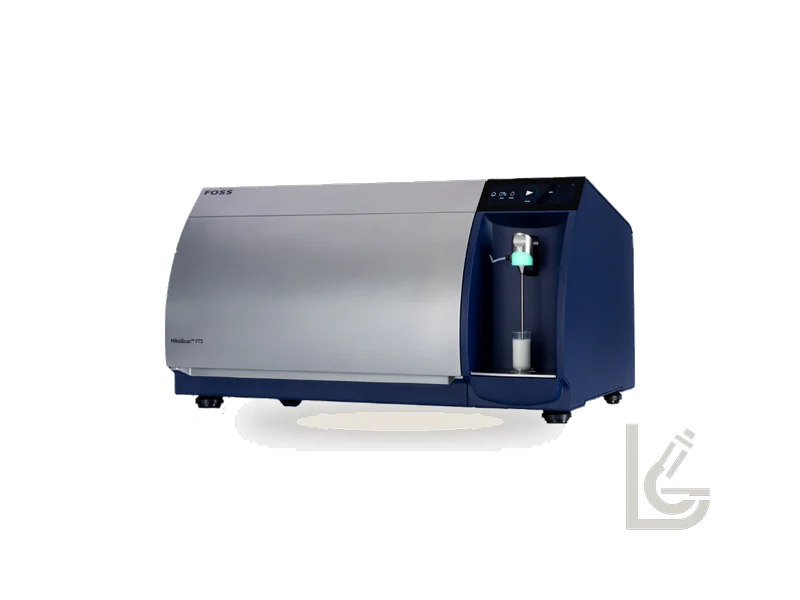
Fat, protein, lactose and solids help assess purchasing value and suitability for processing. GOST 32255-2013 provides the method framework for infrared analysis. LabLog specifies MilkoScan Mars and FT3 as fully compliant with this standard; matrices, ranges and accuracy control are defined during implementation. An ultrasonic analyser cannot automatically be described as following an infrared method.
Compare results with the specification and supplier history. Unexpectedly low protein or solids require a sample check and investigation, not an immediate accusation of dilution.
- MilkoScan Mars: FTIR composition testing at reception, including small and medium plants.
- MilkoScan FT3: extended dairy laboratory analysis within installed matrix calibrations.
- SomaticScan Combo: a somatic cell counter plus an ultrasonic composition module.
- MilkoTester Lite: ultrasonic composition testing; confirm the configured parameters.
Acidity: FOSS, rapid tests and laboratory methods
Titratable acidity can be estimated with a suitably calibrated FOSS MilkoScan or assessed using dedicated rapid tests. Use separate indicator tests or a suitable pH meter for pH. Titratable acidity in degrees Turner (°T) and active acidity (pH) are different quantities without a universal conversion.
LabLog stocks acidity rapid tests. Contact us to discuss the available tests, what each measures and how to interpret the result. The exact range and suitability for milk follow the product instructions.
GOST 32892-2014 describes potentiometric pH measurement. Titrimetric methods are addressed by GOST 3624-92 and GOST R 54669-2011, with different territorial status: Russia uses the latter for milk. Applicability in Uzbekistan must be checked separately. Confirm borderline or disputed screening results using the adopted laboratory method; a strip marked in °T does not by itself perform GOST titration.
- Titratable-acidity rapid tests: select the °T scale or threshold and follow the instructions.
- pH indicator tests: choose milk-compatible range and sensitivity; confirm availability of the specific version.
- pH meter: use a milk-compatible electrode and GOST 32892-2014 potentiometry.
- FOSS Mars: a titratable-acidity calibration is listed by FOSS; FT3 options depend on the package. Verify predictions against the adopted reference method.
- Titration: Steroglass Flash2 and AS Plus can be considered after confirming the milk method, electrode, reagents and calculation.
Adulteration and added water
MilkoScan Mars and FT3 offer targeted and untargeted adulteration screening within the installed models and calibrations. Targeted models address specified substances; untargeted screening flags an unusual spectral profile. LabLog also offers separate adulteration rapid tests: contact us to select the substances and testing procedure.
Added water can be investigated with a cryoscope or a suitably calibrated FOSS MilkoScan. A cryoscope directly measures freezing point; added water generally shifts it towards 0 °C. GOST 25101-2015 describes the freezing-point method. FOSS provides a model-based estimate and screening alongside composition, depending on configuration.
A predicted value is not the same as direct cryoscopy. Interpret it alongside composition, density and natural milk variation. A screening alert calls for holding the batch and selecting a confirmatory test; no alert does not rule out every adulterant.
- Cryoscope: direct freezing-point measurement under the selected method.
- FOSS MilkoScan: model-based freezing-point assessment and dilution screening within configured calibrations.
Somatic cells: BacSomatic or SomaticScan
Somatic cell count supports raw-milk quality assessment and investigation of udder-health problems at supplier level. It is distinct from bacteria count. GOST 23453-2014 covers somatic-cell methods for raw milk. Instrument-specific method suitability and comparability must be established. SomaticScan uses fluorescence microscopy and automated image analysis; BacSomatic uses flow cytometry.
Compare SCC in cells/ml with the acceptance limit. A high bulk-milk SCC calls for investigation with the supplier; it does not identify an individual affected cow or the causative organism.
- FOSS BacSomatic: bacterial and somatic cell counts in one instrument.
- SomaticScan: a dedicated somatic cell counter.
- SomaticScan Combo: SCC plus a separate milk composition module.

Bacterial load and additional risks
BacSomatic rapidly measures bacterial count. Individual bacterial cells (IBC/ml) and colony-forming units (CFU/ml) are different results. Comparison with a culture-based total count requires an accepted, validated conversion or reference testing. The instrument does not identify all pathogens. GOST 32901-2014 covers microbiological methods.
Separate tests used for batch release from planned laboratory monitoring. An analysis that will finish later is not yet evidence of compliance. The control programme sets frequency and any additional contaminant or technological-property tests.
- Aflatoxin M1: Bioeasy Mycotoxin Tests specifically for M1 in milk, with compatible equipment. Feed B1 tests do not replace milk M1 testing. GOST 30711-2001 describes chromatographic methods, not automatic compliance of rapid strips.
- MicroSnap for the indicators in the selected kit; BAX System Q7 for targeted pathogen work after matrix-method verification. Preparation and incubation take time.
- Additional tests follow the control programme: GOST 8218-89 for cleanliness and GOST 25228-82 for alcohol-test heat stability when relevant.
Verify the reception line with Hygiena
Poorly cleaned hoses, connections or tanks can contaminate acceptable milk. Verify cleaning and line readiness before operation. LabLog offers EnSURE Touch and SystemSURE Plus, UltraSnap and SuperSnap surface tests, AquaSnap Total / Free for appropriate water samples, and SureTrend for hygiene records. Match test compatibility and thresholds to the selected system.
ATP indicates residual contamination, not a direct bacteria count or milk antibiotic result. MicroSnap adds microbiological testing of samples or swabs allowed by its method, with incubation and a compatible reader. InSite supports selected environmental monitoring tasks. After a failed hygiene check, apply corrective action and verify again before releasing the line.
Make and record the batch decision
Give each batch a clear status: released, held pending investigation, or nonconforming. An authorised person decides under the approved procedure. Record results and units, method, instrument, kit lot and expiry, quality-control result, operator and decision. Repeating tests until the first negative result is not an investigation.
The values below come from Table 2 of GOST 31449-2013; they are not automatic acceptance limits for every Uzbekistan facility. Check the applicable specification and intended use. The standard’s 4 ± 2 °C requirement concerns cooling after milking and must not be presented without context as the tanker reception limit.
- Fat: at least 2.8%.
- Protein: at least 2.8%.
- Solids-not-fat: at least 8.2%.
- Titratable acidity: 16.0–21.0 °T inclusive.
- Density: at least 1027 kg/m³.
- Freezing point: no higher than −0.520 °C.
- Somatic cells: no more than 400,000 cells/ml.
- Culture-based total count: no more than 100,000 CFU/ml.
- Cleanliness group: II or better.
Filtration and laboratory support
MILKFOR Argentum Plus is a filtration option with antibacterial action. For its Ag+ range, the manufacturer reports bactericidal and bacteriostatic properties and reductions in bacterial contamination and measured somatic cell indicators through removal of impurities and clots. Select the filter for flow, temperature and installation point, and verify performance with comparable before-and-after tests. No fixed reduction or milk sterilisation is guaranteed; filtration does not replace heat treatment, antibiotic testing or assessment of the original batch.
LabLog supports laboratories in Uzbekistan with equipment, consumables, commissioning, training and service. Send your required indicators and samples per shift to discuss an appropriate configuration.
- KERN analytical and precision balances with check weights: sample portions, solution preparation and weighing control.
- FOSS Kjeltec 9, Digestor DT 208/220 and Scrubber 2501: Kjeldahl nitrogen and calculated protein with the adopted method. GOST 34454-2018 is a relevant dairy-method reference, subject to matrix scope.
- FOSS Soxtec and ST 243: laboratory extraction of fat and extractable matter. Select preparation and any hydrolysis for the matrix and method; not a rapid test for each tanker. GOST 5867-2023 does not automatically certify Soxtec for raw milk.
- KERN refractometers: refractive index or Brix for suitable solutions under an established method. Brix is not directly milk protein, lactose or total solids without a validated relationship.
- Steroglass Hyperlab Smart, Basic, Plus and reagent kits: selected enzymatic/colorimetric laboratory assays after validation on milk.
GOST references and method boundaries
The sources below list every standard used in this workflow, covering sampling, composition, antibiotics and inhibitors, acidity, freezing point, density, somatic cells, microbiology, aflatoxins, cleanliness, heat stability, protein and fat.
GOST R 54669-2011 and GOST R 54758-2011 are Russian national standards. GOST 3624-92 has territorial limitations. GOST 5867-2023 replaced GOST 5867-90 in Russia on 1 January 2025: it describes an acid method for milk, while its extraction section concerns cheeses. It cannot automatically be applied to Soxtec and every dairy matrix.
Check scope, current edition and adoption in Uzbekistan before placing a method in the operating procedure. A method standard is not certification of every kit or instrument. ATP, refractometers, strips and filters require product instructions and an established procedure; no universal GOST compliance for the whole configuration is claimed.
FAQ
FAQ
Can one MilkoScan cover every test?+
No. Composition and adulteration screening depend on installed calibrations. Antibiotics and somatic cells require separate tests.
How do SomaticScan and Combo differ?+
SomaticScan counts somatic cells. Combo adds a separate milk composition module.
Can FOSS screen for added water?+
Yes, with the appropriate configuration, using predicted freezing point and other indicators. A cryoscope measures freezing point directly; disputed results need the adopted confirmatory method.
Is an acidity strip sufficient?+
For rapid assessment within its instructions. pH and °T differ; a °T strip does not replace the adopted titration method. Contact LabLog for selection.
Must every test be run on every tanker?+
Frequency follows applicable requirements and the control programme. Release testing, planned monitoring and investigations are different tasks.
Sources and documents
- GOST 31449-2013 — Raw cow’s milk. Specifications
- GOST 13928-84 — Procured milk and cream. Acceptance, sampling and sample preparation
- GOST 32255-2013 — Milk and milk products. Rapid infrared analysis of physicochemical identification parameters
- GOST 32219-2013 — Milk and milk products. Immunological methods for antibiotic detection
- GOST 32254-2013 — Milk. Instrumental rapid method for antibiotics
- GOST 23454-2016 — Milk. Methods for inhibitory substances
- GOST 32892-2014 — Milk and dairy products. Active acidity measurement
- GOST 3624-92 — Milk and milk products. Titrimetric acidity methods
- GOST R 54669-2011 — Milk and processed milk products. Acidity methods
- GOST 25101-2015 — Milk. Freezing-point determination
- GOST R 54758-2011 — Milk and processed milk products. Density methods
- GOST 23453-2014 — Raw milk. Somatic cell methods
- GOST 32901-2014 — Milk and dairy products. Microbiological methods
- GOST 30711-2001 — Foodstuffs. Detection and determination of aflatoxins B1 and M1
- GOST 8218-89 — Milk. Cleanliness determination
- GOST 25228-82 — Milk and cream. Alcohol-test heat stability
- GOST 34454-2018 — Dairy products. Protein by the Kjeldahl method
- GOST 5867-2023 — Milk and processed milk products. Fat methods
- FOSS MilkoScan Mars
- FOSS MilkoScan FT3
- FOSS BacSomatic
- FOSS Soxtec 8000
- FOSS ST 243 Soxtec
- Bioeasy
- SomaticScan
- Hygiena ATP
- MILKFOR Ag+
- KERN