
Meat laboratory
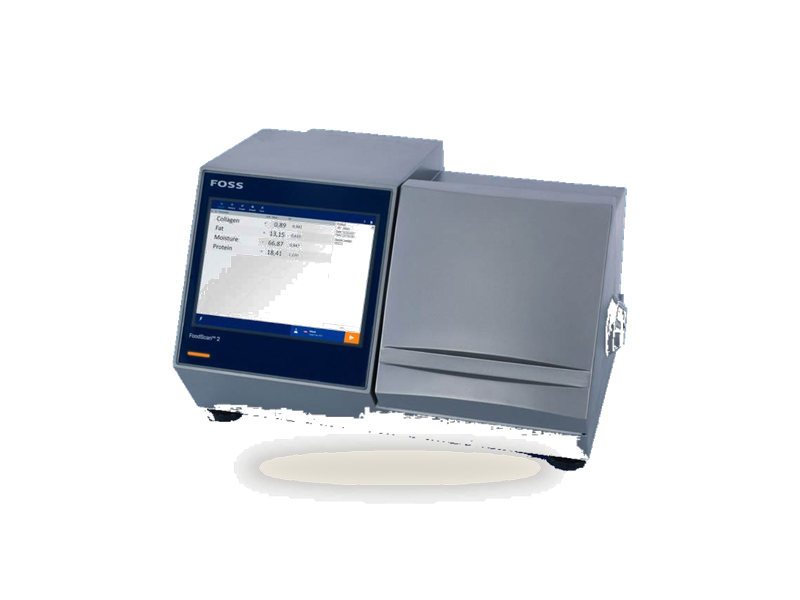
FoodScan 2 Meat: rapid analysis of meat and meat products
In meat production, analysis speed directly affects formulation, yield and batch stability. FoodScan 2 Meat covers routine composition control from incoming raw material to finished product where waiting for classical lab methods is too slow.

What tasks it covers
FoodScan 2 Meat is used for meat raw materials, minced meat, sausage mixes, semi-finished products, finished products, and selected fish and plant-based meat-alternative tasks. Typical parameters include fat, moisture, protein, collagen, salt, ash and calculated values by product matrix.
Why it is more than a composition analyser
In the official FOSS range, FoodScan 2 Meat combines composition, CIE L*a*b colour and batch standardisation. This matters when a plant needs not only fat or moisture values, but also a consistent product from batch to batch.
Where the effect appears
Fast composition results help adjust recipes before a batch is released, keep mince stability, reduce overuse of expensive raw materials and investigate quality deviations faster.
FoodScan, NIRS DS3 or MeatScan: how to choose
If the main task is rapid routine control of meat products, FoodScan 2 Meat is usually the dedicated choice. If several industries and matrices must be covered, NIRS DS3 with additional calibrations should be considered. If the task is narrower — for example rapid fat standardisation in meat raw material — MeatScan can be compared separately.
Standards and result verification
For NIR methods in food and feed matrices, ISO 12099 and GOST ISO 12099-2017 provide the methodological framework. For meat tasks, the FOSS-stated AOAC approval for FoodScan 2 Meat is also important. In practice, calibrations still need to be verified on your products, raw materials and parameter ranges.
A representative sample matters more than speed
Meat products are heterogeneous in fat, moisture and connective tissue. Sample according to an approved batch plan and document grinding and cup-filling technique. FoodScan 2 measures a broad area and reduces dependence on perfect homogenisation, but cannot correct unrepresentative sampling.
Mince, emulsions, sausages and raw materials may require different preparation and calibrations. Do not transfer a procedure between matrices without verification.
Calibration and reference verification
The instrument predicts fat, moisture, protein, collagen and salt from spectra using the selected calibration model. Before routine use, verify that the model covers actual recipes and ranges by testing local samples in parallel with applicable reference methods.
Then use controls, repeats and bias trending. If raw-material suppliers, recipes or processing change, reassess model suitability.
Where a rapid result changes the process
FoodScan 2 can support checks before blending, after blending and before batch release. A technologist can adjust formulation before filling and heat treatment rather than discovering a deviation after production. Each parameter needs a target range, repeat rule and defined authority to adjust.
Build the business case from avoided rework, overuse of costly ingredients and laboratory delay—without a universal payback promise.
FAQ
FAQ
Does FoodScan 2 Meat replace the classical laboratory?+
It covers rapid routine control and helps make process decisions faster. However, calibrations and procedures must be verified with reference methods and the laboratory’s internal rules.
Is sample homogenisation required?+
FoodScan 2 reduces dependence on perfect homogenisation, but preparation must match the matrix and verified procedure. Representative sampling remains essential.
Sources and documents