
Hygiena: essentials explained
Salmonella in food production: from sample to decision
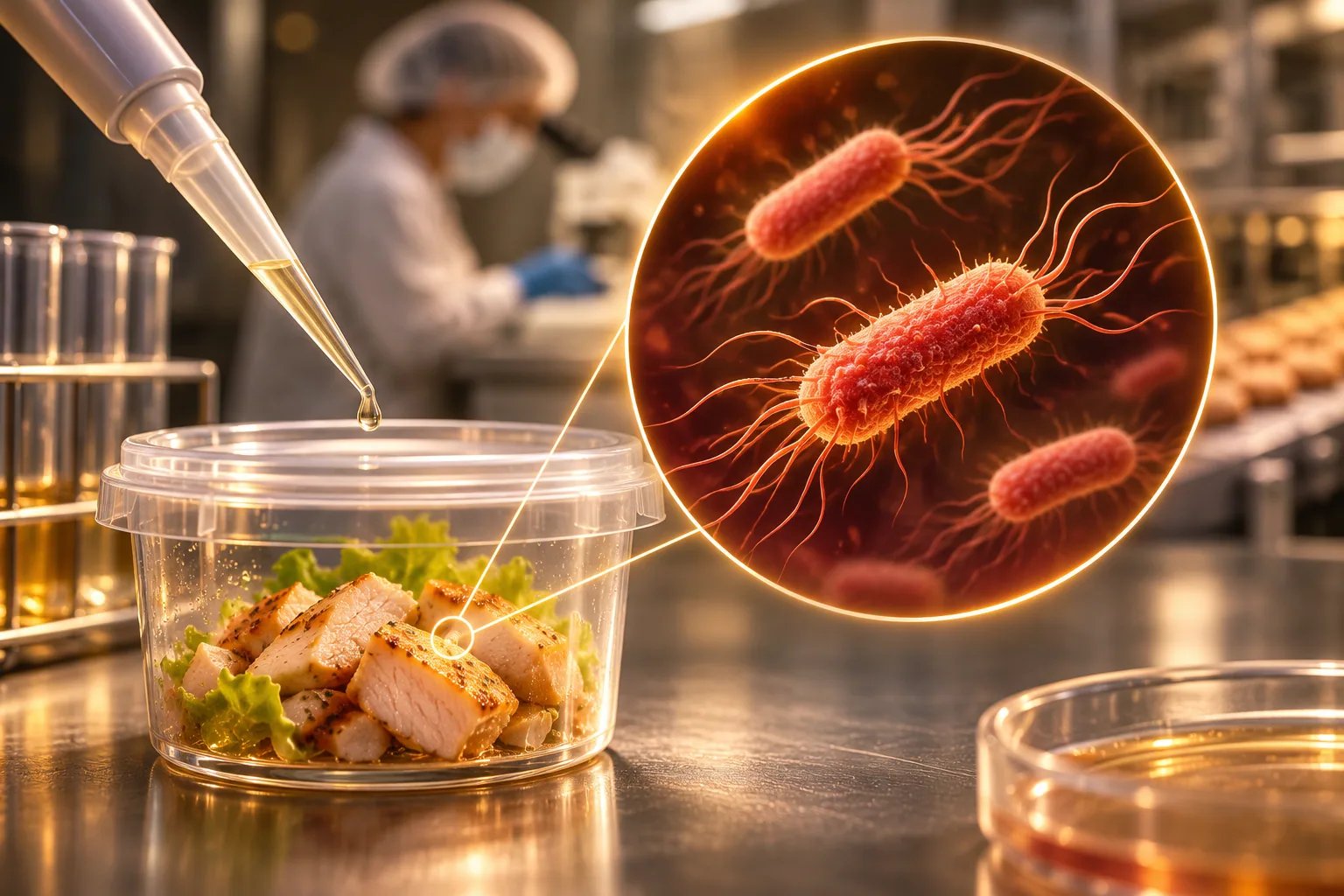
A batch is ready for dispatch. The laboratory is testing a sample for Salmonella and production is waiting. What must happen between sampling and a decision about the batch? What does “not detected” actually mean? Follow the journey from a well-defined testing question to the responsible person’s next action.

In short
Quick selection
The sample journey at a glance
Sample
- Purpose
- Connect testing to the product and decision
Enrichment
- Purpose
- Support subsequent detection of the target
DNA extraction
- Purpose
- Prepare material for molecular testing
PCR and controls
- Purpose
- Detect the target and assess test validity
Decision
- Purpose
- Follow the prescribed response
Timing and conditions depend on the selected method and product.
Three checks that answer different questions
Our earlier articles covered cleaning checks, MicroSnap versus PCR, and building a monitoring programme. Here we apply those ideas to one specific task: testing for Salmonella.
ATP testing helps assess surface cleaning. Indicator microbiology addresses selected groups of microorganisms. A Salmonella test targets a particular organism. A satisfactory cleaning check does not replace targeted testing; a product result does not automatically describe the whole production environment. These checks complement each other.
Define the question before taking the sample
Raw material, finished food and an equipment swab are different sample types. Before testing, the laboratory needs to know what was sampled, where, when and for which decision. The sampling plan, transport conditions and traceability matter as much as the instrument.
Consider an illustrative case: one pack from a large batch reaches the laboratory. Even a correctly performed test concerns the sample examined. How well that sample represents the batch depends on the sampling plan. A more expensive instrument cannot repair unrepresentative sampling.
The sample journey starts before the PCR run
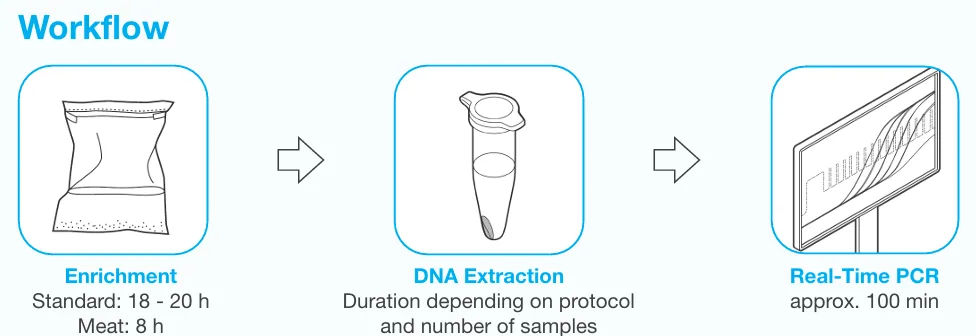
Molecular testing of food commonly includes enrichment to support subsequent detection when target contamination is low. DNA is then extracted from the prepared material. PCR looks for a defined genetic target, and the laboratory assesses the signal alongside control reactions.
Each stage has a purpose. The essential sequence is: sample → enrichment → DNA extraction → PCR → result assessment. Operating conditions come from the selected method’s instructions. This overview explains the logic; it does not replace a laboratory procedure.
Count the full time to a usable result
Instrument runtime and reporting time are different. The full turnaround includes preparatory stages, sample handling, quality checks and confirmation where required. Promising an answer within the PCR runtime alone leaves out essential conditions.
A rapid protocol belongs to a particular product and method. A schedule for a meat sample cannot automatically be transferred to milk powder or chocolate. LabLog evaluates the complete workflow, from sample receipt to a result the site can use.
“Not detected” comes with conditions
“Not detected” refers to the tested sample, the chosen method and a correctly completed procedure. It is not a statement about every pack in the batch. If a control identifies a problem, such as sample-related reaction inhibition, absence of the target signal cannot automatically be treated as a reliable negative.
A positive screen triggers the prescribed response: holding affected product under the site’s procedure, investigation and confirmation when required. Repeated sampling until a convenient negative appears does not cancel an established positive result. Authorized specialists decide the batch disposition using all applicable requirements.
What a method certificate establishes
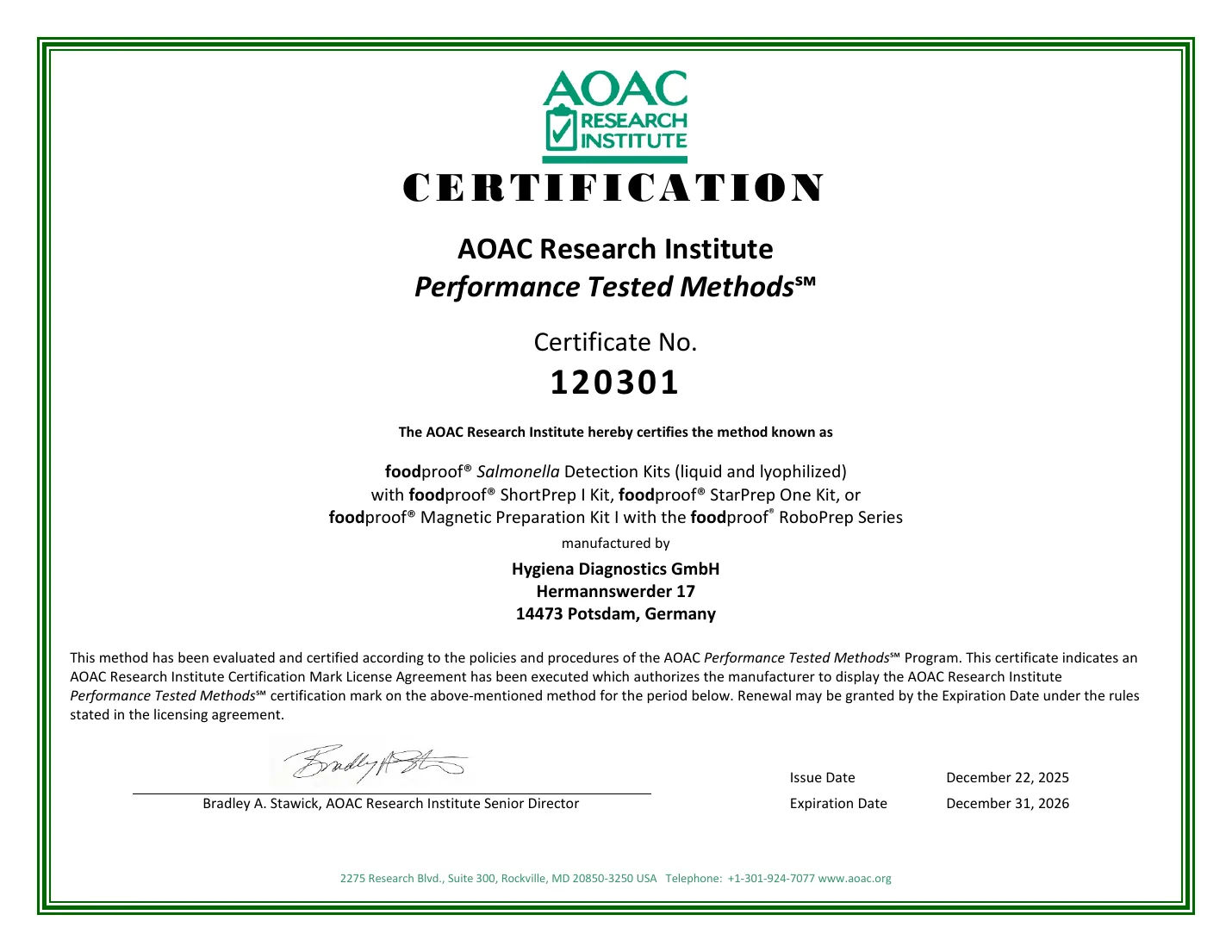
Read a certificate together with its scope: products studied, kit version and sample-preparation combinations evaluated. Method validation and a particular laboratory’s ability to perform it are related but different questions.
For example, AOAC PTM No. 120301 covers specified foodproof Salmonella variants and preparation combinations. It does not automatically cover any reagent-and-instrument combination. Acceptance for official testing or a customer’s requirements must be checked separately. An international certificate alone is not blanket authorization for every testing context in Uzbekistan.
Hygiena and LabLog: build the right workflow
Hygiena offers targeted foodproof solutions for Salmonella detection. Selection starts with the product and purpose, followed by checks of the test version, preparation method, instrument compatibility and documentation. One kit’s performance cannot be attributed to every PCR product.
LabLog helps select a solution and arranges supply, commissioning, training, consumables and technical support in Uzbekistan. Tell us your product, expected sample volume, required turnaround and existing equipment. Also specify whether testing is for internal control, customer requirements or official purposes. This allows us to plan the complete workflow rather than only a reagent purchase.
FAQ
FAQ
Can a routine ATP test detect Salmonella specifically?+
No. ATP cleaning verification does not identify a microbial species or replace targeted testing.
Is a positive PCR always the final result?+
The method and testing purpose determine further action and confirmation requirements. A positive screen requires the prescribed response.
Sources and documents