
Hygiena: essentials explained
Looks clean. But is it properly cleaned? ATP testing explained
The line has been cleaned. Steel shines, utensils are ready and the next shift is waiting. But appearance cannot tell you whether product residues have been removed. ATP testing helps check cleaning while there is still time to correct a problem before equipment touches the next batch. Here is how a number on a screen becomes a useful action.

In short
Quick selection
The essentials in one minute
Sample
- What matters
- Same point and technique
Result
- What matters
- Compare with site limits
Action
- What matters
- Record, correct, retest
What the instrument detects
ATP is a molecule involved in cellular energy transfer. It occurs in microbial cells and food residues. A swab collects material; a reagent produces light, and a luminometer measures it. The result is expressed in relative light units, or RLU.
This is neither an image of contamination nor a bacterial count. The instrument does not identify milk, plant residue or a microbial species. It reports the ATP signal in the sample. Fat and protein are not measured directly by this test; protein residues and specific allergens require appropriate separate methods.
Ask the right question
The useful question is: “Does this sampled point meet our cleaning criterion?” It is not: “Is Salmonella present?”
A low reading does not prove sterility or the absence of pathogens or allergens. A high reading does not identify an organism. ATP checks and microbiology therefore complement each other: one supports immediate cleaning control, while the other answers specific microbiological questions.
Five actions that make the result useful
First select and identify the sampling point. Product contact, joints, seals and recurring problem areas matter more than convenience. Collect each sample consistently from a defined area, following the test instructions.
A typical UltraSnap application checks a surface after cleaning and rinsing, before sanitizer application. If a site tests at another stage, chemical compatibility must be considered because cleaning chemicals can affect the signal. Compare the reading with that point’s limits, record it and follow the agreed action. A number without a location, time and decision has limited value.
Why another factory’s limit is not yours
RLU belongs to the instrument-and-test system. The same number on different platforms need not represent the same ATP amount. Sampling area, surface material and product characteristics also matter.
Manufacturer guidance provides a starting point. Working limits need supporting data from consistently effective cleaning and a risk assessment. Repeated failures are not a reason to simply raise the limit. Investigate cleaning, sampling technique, test storage and instrument condition first.
Example: a seal hides the problem
Training example: an accessible tank wall passes after cleaning, but its seal area fails. Rechecking only the wall until the report looks good solves nothing. Hold the affected equipment, clean the area according to procedure and retest the same point.
Repeated failures call for investigation of disassembly, seal wear, cleaning-solution access and operator technique. This turns a measurement into root-cause analysis. Equipment readiness still depends on the full sanitation procedure, including required disinfection and other checks.
Choose equipment for the task
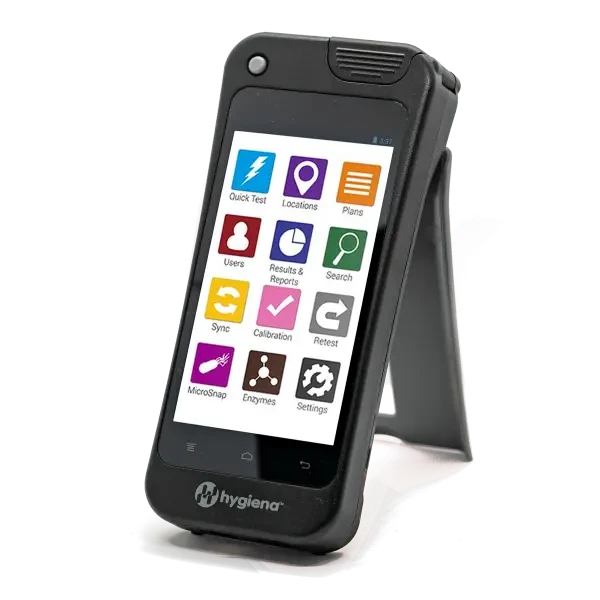
UltraSnap is used for surfaces; an appropriate AquaSnap version is used for water samples, including rinse-water checks. EnSURE Touch supports a digital monitoring programme, while SystemSURE Plus offers a simpler ATP workflow. Check compatibility for the selected test.
LabLog helps select a system, define monitoring points and train staff in sampling and interpretation. We arrange consumable supplies and technical support in Uzbekistan. Start with one area, establish a repeatable procedure and then expand the programme.
FAQ
FAQ
Does a zero reading mean there are no bacteria?+
No. An ATP test does not establish absence of bacteria or sterility.
Must every point be tested daily?+
Set frequency according to risk and failure history. Critical and recurring problem areas require particular attention.
Sources and documents