
Lactose-free dairy
Kerry lactases and LactoSens: how lactose-free dairy is produced and controlled
A lactose-free product does not start with a label. It starts with a controlled process: choosing the enzyme, maintaining hydrolysis conditions and confirming residual lactose with a clear control method.

In short
Why lactose-free dairy is a process task
Lactose-free milk, yogurt or kefir cannot be made only by feel. The plant needs to understand the product matrix, process temperature and pH, hydrolysis time and the residual lactose level that must be confirmed.
So the discussion does not start with “which lactase should we buy”, but with “which product are we making and how will we prove a stable result”. For a dairy plant this is about quality, labelling, brand trust and batch-to-batch repeatability.
What lactase does in simple terms
Lactose is milk sugar. Some people do not produce enough lactase, so regular milk can cause discomfort. Industrial lactase does this work in advance: it breaks lactose into two simpler sugars, glucose and galactose.
The process has a useful side effect: the product often tastes slightly sweeter without adding sugar. But the main task for a plant is not simply to add an enzyme. It is to control hydrolysis depth and confirm that residual lactose is within the target level for the product specification.
NOLA® Fit and Ha-Lactase™: process-specific lactase selection
Kerry offers different lactases because dairy products are very different. Milk, UHT products, yogurt, kefir, cheese and drinks have different pH, temperatures, process times and flavour requirements.
NOLA® Fit is a bifido-lactase from Bifidobacterium bifidum. It is considered for products where activity across a broader pH range and stable performance matter, including fermented products, yogurt, kefir, UHT and other dairy matrices.
Ha-Lactase™ is a classic yeast lactase from Kluyveromyces lactis. It is a well-understood industrial solution for milk, beverages, cheese and processes where predictable enzyme behaviour and later heat treatment are important.
- Enzyme selection depends on product, pH, temperature, hydrolysis time, packaging and target residual lactose level.
- LabLog helps not only supply lactase, but connect it to the real production process in Uzbekistan.
Where Kerry lactases are used
The main area is lactose-free and low-lactose dairy production: drinking milk, UHT milk, yogurt, kefir, fermented products, cheese products, dairy drinks and products for specific consumer segments.
In practice, the technology can differ: enzyme addition before filling, tank hydrolysis, aseptic dosing or a scheme designed for a specific product. There is no universal recipe; a good project starts with the plant process map.
Why LactoSens® is needed
Reducing lactose is only half of the task. The other half is proving the result. If a product is positioned as lactose-free or low-lactose, the plant needs clear residual-lactose control.
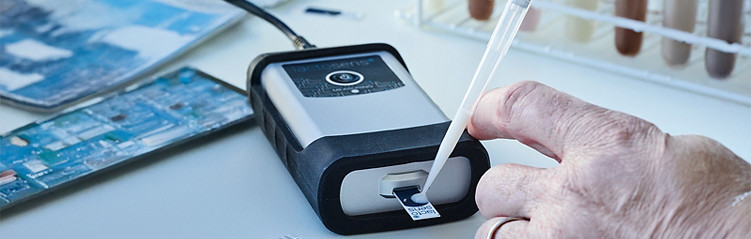
Classic laboratory methods can be accurate, but they often require time, equipment and trained staff. LactoSens® is designed as a rapid production tool: it helps obtain a quantitative residual-lactose result in about 3 minutes when the method is followed.
How LactoSens works in simple terms
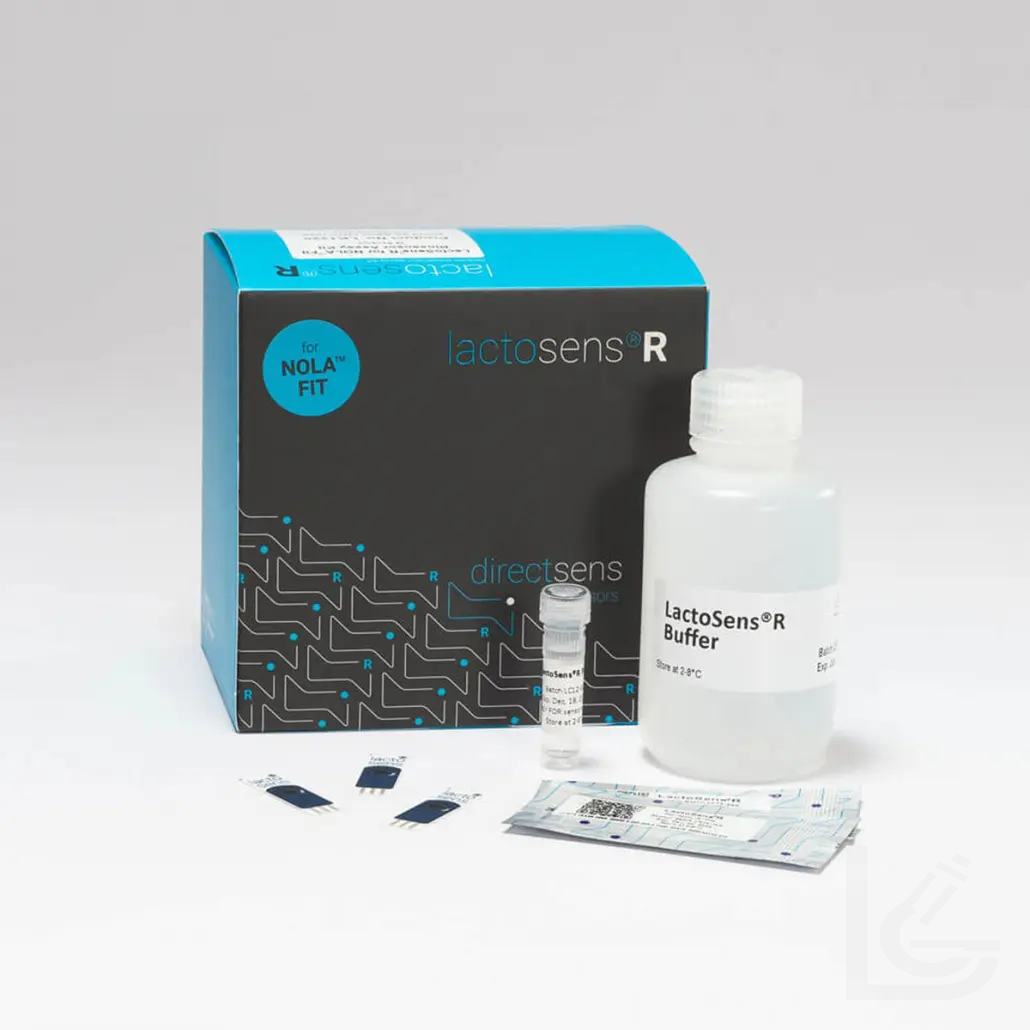
LactoSens®R is an amperometric biosensor. In simple terms, the test system contains an enzyme that reacts specifically with lactose. This reaction creates an electrical signal, and the reader converts it into residual lactose concentration.
The method is practical because the operator does not work with a complex chemistry workflow, but with a clear kit: sample, buffer, sensor and reader. Like any control method, it still requires discipline: correct sample preparation, timing, temperature and adherence to the manufacturer instructions.
What supports the method
For industrial control, speed and convenience are not enough. Independent method validation also matters. LactoSens®R is described as AOAC Official Method 2020.01 for determining low lactose levels in milk and dairy products. The method has also undergone NordVal validation.
This does not replace plant procedures, market requirements or local quality rules. But a recognised method is a strong argument for technologists, laboratories and quality teams: the solution can be discussed not only as convenient, but as a method.
How LabLog helps implement Kerry in Uzbekistan
LabLog Group supplies Kerry solutions for dairy plants in Uzbekistan and helps connect the technology to the real task of the plant. We discuss the product, process, target residual lactose level, current control method and staff requirements.
Our goal is for the plant to receive not just an enzyme or instrument, but a working system: an enzyme matched to the product matrix, a clear control method, staff training and an implementation plan without overpromising.
- Selection of NOLA® Fit or Ha-Lactase™ according to product, pH, temperature, hydrolysis time and packaging format.
- Supply of LactoSens® and consumables for residual lactose control.
- Staff training: sample, method, result interpretation and routine batch control.
FAQ
FAQ
What is lactase?+
Lactase is an enzyme that breaks milk sugar lactose into glucose and galactose. In production it is used for lactose-free and low-lactose dairy products.
How is NOLA® Fit different from Ha-Lactase™?+
NOLA® Fit is a bifido-lactase from Bifidobacterium bifidum and is considered for a broader range of dairy matrices and pH. Ha-Lactase™ is a yeast lactase from Kluyveromyces lactis and is well understood for classic dairy processes. Selection depends on product and production conditions.
What does LactoSens® show?+
LactoSens® provides a quantitative residual-lactose result in milk and dairy products. It helps quickly check whether the target residual lactose level has been reached for a specific batch.
Can lactose-free products be made without rapid control?+
Control can technically be organised in different ways, including classical laboratory methods. But rapid control close to production helps make faster batch decisions and manage the process more consistently.
Does LabLog supply Kerry in Uzbekistan?+
Yes. LabLog Group represents Kerry solutions in Uzbekistan: NOLA® Fit and Ha-Lactase™ lactases, the LactoSens® system and consumables, and helps with selection and implementation.
Sources and documents